Interviewing

Handshake, originally uploaded to Flickr by SvadilfariReader J wonders how she can turn a temporary job into a permanent job, but is nervous because she already knows the interviewers…

After being laid off from an in-house counsel position several months ago, I obtained a part-time, temporary position in the same industry. After being here a couple months, the company opened up a permanent, full-time Associate General Counsel position. The job description is broader than what I am doing as my temp assignment, but I believe I am well-qualified. I also really like the company and my co-workers. I submitted my resume, and HR just contacted me to schedule interviews for next week.

What makes this situation unusual is that my interviewers will be the GC and others with whom I already interact on a daily basis. I think I interview pretty well; I have been offered nearly every job I have interviewed for since graduating from law school. But I am very nervous about this temp-to-perm scenario.

Congratulations on making it through to the first round of interviews! We’ve talked about how to change jobs within companies before, but we haven’t really talked about how to interview with your current colleagues and coworkers.  To be honest, I’m not quite sure I understand your nervousness — this sounds like a great situation from all angles. From my perspective: your interviewers know you and your work product, you already know a bit about them and how to play the interview, it should be easy to figure out what the interviewer is “really” asking, and you probably have a better understanding of the new job and its demands. When I interviewed for my last legal job (at the non-profit), I already knew my future boss, having interned at the non-profit during law school and having kept in touch with her through the years.  I viewed that as a positive thing because I knew what to expect on the interview.  Don’t get me wrong, I did my homework, just like I would have for any job interview: I scoured the non-profit’s website, I read up on the particular area of the law that they wanted the new position to focus on (I read an entire treatise the nonprofit had put out on the subject, actually), I went through recent newsletters and publications to find other new cases and issues to discuss at the interview, and I did my best to figure out what was “missing” or what I could add.  (And yes, I wore a suit, even though I knew it was a business casual office.) I always advise anyone going on a job interview to focus on what you bring to the job, but here that “let me help you” vibe was magnified because I was excited to show my potential boss how I could make an impact in the job, how my background would be perfect for the position, and how my approach to the job would be the right one.  I also went into the interview with the theory that if she didn’t like my approach, or if she found another candidate who was better qualified — well, so be it — and I like to think that we would have stayed friendly even if I hadn’t gotten the job.

[click to continue…]

{ 42 comments }

A recent SNL episode featured a fictional campaign advertisement for a mayoral candidate.  The character, Glenda Okones (played by Kristen Wiig),  listed her flaws, including her reputation for being harsh and cold.  “Here’s why,” she said:  “I just have a naturally frowny face. Not ugly, but certainly severe looking.”

Ah, perfect, I thought: an opportunity to talk about bitchface.

I’ll admit: the main reason we haven’t talked about it before is because I didn’t want to use bad words in the headline of the post!  But I think this is something that can affect a professional woman’s career, and something we should talk about.

[click to continue…]

{ 168 comments }

Reader K asks about the merits of cheap suits for women…

I’m in the process of changing from a career where pajamas are appropriate work attire to something more “professional” and need all the help I can get. I have been shopping for an interview suit (my first ever and I am almost 40!) and am not sure how to weigh quality vs cost. My clothes budget has been limited to a few t-shirts, a pair of jeans, and maybe a sweater per year so I am unaccustomed to spending a significant amount of money on clothes. I have been browsing at discount stores like Ross, Marshalls, and Kohls to try and find my interview suit for under $100. However, the more I read your blog the more I am wondering if I should suck it up and spend $200-300 on a suit that is wool from a store like Ann Taylor or Banana Republic. Aside from the fact that a well made wool suit will last longer than a synthetic Calvin Klein suit from Ross, do you think there is a significant visual difference? I figure that if my cheap suit works for the interview I can always invest in quality clothes once I have a job that pays more. However, the last thing I want is for the interviewer to think “damn, that’s a cheap suit!”. Any advice?

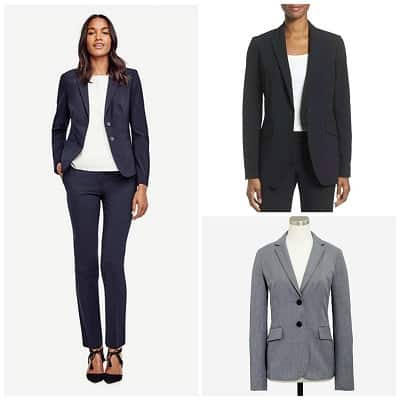
Great, great question, and I think we should expand the discussion to the differences between LOTS of different price ranges. (The pictured suit is actually not a cheap one, but rather an expensive one — I’ve just been looking for an excuse to share it with you guys without recommending it.  Tee hee.) Here’s my take:

- Under $100. There are lots of suits to be found for under $100, but in general these are going to be sold as a single “suit” — one price for both the jacket and bottoms, whether you’re getting pants or a skirt. While the skirts can sometimes look OK when worn as a separate, the pants almost never do (at least, that’s my experience). Furthermore, because these suits are so inexpensive, the fabric they’re made of is often difficult to work with and may wrinkle easily, hold smells more easily, and start to get a bit shiny when you dryclean them. Bottom line: These suits are great for when you want to bolster a professional wardrobe — particularly if you have to wear suits 5 times a week — but for my money, I would not purchase this kind of suit for an interview/wardrobe basic.

- Under $200. There are suit separates to be had for under $200, particularly at mall stores (think The Limited, Express, or LOFT), as well as at department stores (Macy’s in particular has a number of “Every Day Value” separates from AK Anne Klein, Ellen Tracy, and Calvin Klein). These will be in basic, solid colors, you can get both pants and skirts (and maybe even multiple jackets) to match, in separate sizes (perfect if you need an 8 on top and a 6 in the bottom). The fabric will not be the best (see above), but in terms of bang for your buck, you’re going to get a lot more wear out of these pieces as a wardrobe staple as WELL as an interview suit. Furthermore, if you have to interview twice, you can wear the skirt once and the pants the next time, instead of wearing the same suit. You can also get a better suit that’s sold as a single unit for around $150 or so — I’ve had good luck with Tahari suits off the rack at Macy’s. Bottom line: If you’re working on a very limited budget, these suits are going to be a better use of your money, give you more wardrobe flexibility, and generally look better than the $100-and-under category.

- $200-$500. This is where your ability to watch sales is going to come into play, because it’s pretty common to see a $500 suit go on sale for under $250 if you know what you’re buying. This price range puts you into the better mall stores — Ann Taylor, J.Crew, Banana Republic — and you’ll start to see better fabrics here, such as natural fibers (look for wool you can wear year-round) as well as suiting separates. These suits are going to wear better, fit better, and be easier to wear as separates than any of the cheaper categories.

- $500-$1000.  The fabrics just keep getting better as you get into the range of Theory, Elie Tahari, Nanette Lepore, Rebecca Taylor, Hugo Boss, and more.  In addition to seeing some great basics (Theory suits are, of course, a perennial favorite), there are some more interesting, lovely suits (as we frequently discover in our Suit of the Week feature).

- $1K+.  I’m sure there are differences in the fabrics and fit for this price range, but let’s just say it:  if you buy a suit in this price range it’s pretty much a) to cross something off your Fashion Bucket List, or b) because you’re so rich the price just does not matter.  (Neither of those are bad reasons!)

Ladies, what differences do you see in different price ranges for suits?  How much does YOUR average suit cost (both in terms of sticker price and in terms of what you’ll actually pay, after any discounts)?

{ 142 comments }

Steve's 80's Party, originally uploaded to Flickr by Bob. B. Brown.Reader C has a great question about thank yous to your references…

I’m anxiously awaiting a few job offers–and am wondering if a $100 gift card to a delicious local restaurant is an appropriate thank you for each of my references? (The potential offers are for healthcare-related opportunities–hospital positions and consulting gigs.) What have you done in the past?

I first misread this question as how to thank your interviewers. (No gift cards to interviewers!) I think this is a cute idea, but one that could be tweaked to make it even better:

Instead of gift cards, take your references to lunch. Ask their career advice, what they think your strong suits are heading into any new job (and, just for your ears, what they think your weaknesses might be!). Ask them how they got to where they are, what they might have done differently given the clarity of hindsight. And then… stay in touch with them. Tell them how you’re doing, ask them to lunch once a year or so and see how they’re doing.

This is how you turn a work colleague into a mentor, at least in my experience. But if you’re far away, a gift card is a nice idea. (Although, truth be told, I don’t think I’ve ever thanked my references with any specific “gift”!)  (Pictured above: Steve’s 80′s Party, originally uploaded to Flickr by Bob. B. Brown.)

Readers, how do you thank the people who serve as your references on your resume?

{ 82 comments }

kate spade new york Nylon Maryanne ToteiconSure, we all know what basics professional women are supposed to have in their closets, but if you’re buying one for the first time or replacing one you’ve worn into the ground, it can be a pain to find exactly the right incarnation in stores. In “The Hunt,” we search the stores for a basic item that every woman should have.

I feel like a good black tote bag is something every professional woman needs — particularly if you’re gearing up for interviews.  They’re large enough for a folder with your resume, as well as some reading or work (should you find yourself waiting or with some free time), and they’re also great for stashing all of the items you generally carry in your purse.  Readers, have you recently purchased any great black tote bags?  Do you have a classic that you’ve been using for years?

London Fog "Miranda" Tote & Clutch SetI’m not generally a fan of faux leather, but it’s hard to beat the price for this one (at least as far as online sales go): it was $135, now marked to $70. London Fog is a respected name, and I like that it comes with a clutch. It’s 16.25″ at the widest point, 11.5″ high and 5.75″ deep — plenty of space. It was $135, now marked to $69.99 at SmartBargains.com. London Fog “Miranda” Tote & Clutch Set
$220 seems like a lot for a nylon bag, but I actually prefer nylon for tote bags because I think it wears better and is lighter weight. This is just a basic black bag, but I like the internal pockets (including one for your ipad and cell phone), and there are removable and repositionable interior dividers. I like it in black for work, but there are a number of fun colors marked 30% off which might be better for a general purpose “tote bag.” The black is $220 at Mandarina Duck. Mandarina Duck Unexpected Shopper
Tumi is another brand I know and like, particularly for business bags for men and women. I like the leather and nylon combination of this one, as well as the little details like the feet on the bag and the interior pockets. It’s $345 at Amazon. Tumi Voyageur Derby Business Tote
kate spade new york Nylon Maryanne Tote
iconI’m actually most excited about this bag — it seems like ages since Kate Spade had a good nylon tote out. I like the hardware for a bit of interest, as well as the feet, interior pockets, and fun lining. It’s $395 at Bloomingdale’s. kate spade new york Nylon Maryanne Tote
Longchamp Roseau Patent East West ToteI like the durability of patent leather for something like a tote bag — it’s easy to clean and can generally take a lot of use. This East/West tote is simple and basic — I like the slim shoulder straps as well as the toggle closure. It’s $475 at Bloomingdale’s. Longchamp Roseau Patent East West Tote
Fendi black 'Roman' leather 'Selleria' medium tote Hello, lovah. This Fendi bag has me drooling — the pebbled leather! the contrast stitching! the three interior compartments! It’s even on sale at Bluefly: was $2250, now marked to $1620 (including an extra 10% off). Lovely. Fendi black ‘Roman’ leather ‘Selleria’ medium tote

Like this feature? Check out other recent installments!

(L-all)

{ 89 comments }

Old SchoolShould your Greek affiliations be on your resume?  Reader C wonders…

I’m a current undergrad applying to law schools this fall and am finalizing my resume. I have a fairly senior professor/administrator who insists that students not put their Greek affiliation anywhere on their resume because he worries that being in a sorority/fraternity (or even the “wrong one”) could hurt a chance of a job/admissions offer. I held a leadership role in my sorority (one where there was no committee under me, but I did initiate and successfully complete some large projects) and was also a recruitment counselor for Greek life for two years (a highly competitive position at my school). If I omit these positions, my resume is rather sparse in the leadership category. Do you have any suggestions? Should I say that I was in Greek life, but leave the name of the sorority off? Or can I hope that I won’t be judged to be a shallow, snooty “sorority girl” before they meet me?

I was not a member of a sorority in my undergrad years — something that I slightly regret now.  I went about halfway through the “rush” process, but dropped out of the process before pledging (I seem to remember some frenzied late-night conversation with friends — you know the kind in college, where the World Suddenly Makes Sense — about how “sister” meant more to me than “group of girls I live with” and therefore I should drop out of the process.)  In terms of my college social life, I don’t regret the decision at all — my friends and I had great fun, and I was very involved with a more subject-specific “residential college,” as NU called them — but in the <cough> many years since college, I’ve come to wonder whether a sorority affiliation would have been helpful from a networking perspective.  I seem to remember there being a slight bias against the Greek system from professors, administrators, and a lot of students* as well. (Pictured: I just rewatched the movie “Old School” and laughed really hard — I recommend it if you haven’t seen it!)

Now, that said, should Reader C put her leadership positions on her resume? Well… I’m not sure.  In the “applying to grad school” context, I think there may be a bias against sorority girls and I think your professor might have some good points.  I’m also not sure whether “leadership” is really a quality that grad schools are looking for, above and beyond, say, critical thinking, researching, and writing skills.  I often talk about my theory of preparing for an interview by thinking of three great traits, with stories to accompany them — I wouldn’t have a problem with you pulling a story from your leadership experience at the sorority.  But in terms of written application materials, I might leave your sorority experiences as one-liners in a “Other Interests” type of section.

Ultimately it depends what else your resume looks like, though — if you really have very little work experience then a sorority-filled resume is better than an extremely sparse resume.  However you put it on your resume, I think it would look very weird to leave off the specific affiliation and just “say you were in Greek life.”

All right, ladies, I’m curious — how many of you were in the Greek system in college?  How has it affected your professional lives since — have you used your sorority as a networking tool? And, of course, what’s your advice to Reader C?

*I will always, always, always remember taking a psych class in college and having a teacher ask the class, “What affiliation are you?” and hearing a student immediately call out, loudly and proudly from the front row, “GDI.”  “What affiliation is that?” asked the professor.  “Gawwwwd Damn Independent,” she said just as loudly and proudly. Ohhhhhhh-kay.

(L-2)

{ 241 comments }

Terms of Use; Privacy Policy