Business Etiquette

Food for the trail, originally uploaded to Flickr by trekkyandyReader S has a business etiquette question about eating during business meetings…

I have an business etiquette question. I have low blood sugar and have to eat every couple of hours. Is it rude to eat something that can’t be shared, like a piece of fruit, during a meeting? In today’s example, we didn’t have a break, and the senior person passed around a tin of cookies, so I assumed it was OK to snack. Otherwise I wouldn’t be able to pay attention….

Hmmn. I’m a big believer in the importance of keeping your blood sugar level steady for energy, brain power, and mood purposes, but I’m not sure about Reader S’s question.   I guess the answer here depends on the kind of meeting. If everyone is eating (or it’s a BYO kind of lunch meeting), I think its fine to bring something of your own, whether it’s shareable or not. I would, however, pay mind to whether or not your snack might be disruptive — if it is loud (crunchy apple? crinkly wrapper?), smelly, or involved (such as if you need to set up a staging area to spread cheese or peanut butter on top of something), I would strongly suggest you reconsider bringing it to a meeting, even if people are eating.  (Pictured: Food for the trail, originally uploaded to Flickr by trekkyandy.)

If, however, people are not generally eating, then you have fewer options. First, you could rely on liquid calories — take your sugar with coffee and cream, so to speak. (Or just fill your cup full of milk or soy milk when everyone else gets coffee.) The second best option would be to excuse yourself to the bathroom and eat a few quick bites of something filling, preferably in the “lounge” area of the bathroom that a lot of offices have (and not in, you know, the actual stall). My list of quick and stashable bites would include things like a handful of almonds or trail mix, a banana, or even an energy bar.

All this, of course, presumes that it is a Long Meeting (2-3 hours) — if it is less than that I would really suggest you bend your eating schedule around the meeting.  If it’s a Very Long Meeting (3+ hours), of course, the planners will hopefully/probably build bathroom and snack breaks into the meeting.  (If you are one of the planners for the meeting, implement one!)  If you regularly have Long Meetings or Very Long Meetings with the same players, you might just take a moment to explain to them that you need to eat every few hours and see how they react.  (If this were me, though, I would still probably excuse myself when I needed to eat, unless I was assured it was ok to eat anyway.)

Readers, what are your thoughts on munching during meetings?

{ 160 comments }

It's a girl!... originally uploaded to Flickr by duncanReader M has a question about gender-neutral names…

I am a new practicing attorney with a gender-neutral name. I’ve been in practice since October (4 months) and have already received at least 10 correspondences addressed to “Mr. Last Name.” Aside from making a phone call to the offending party and changing the footer in my email to all pink, is there a way to politely correct individuals about my gender?

Excellent question! I think you have a few options. (Pictured:  It’s a girl!… originally uploaded to Flickr by duncan.) The obvious one, sadly, is to not care so much — after all, the issue will be resolved if the correspondence continues, and the egg is really on the other party’s face right now. But you can do a few things to improve the odds of getting a properly-addressed correspondence, particularly if the other party cares about these things:

First, make sure you have a picture on your company’s website (if it isn’t already mandatory). Check out some of our previous advice on how to take a good corporate headshot here. If you don’t have a photo, but have a bio, do your best to use feminine pronounces. “Ms. ____ recently wrote these three articles.”

Second, manage your online presence. Sign up for Linked In and attach a picture to the account, and make your profile picture on Facebook visible.  A lot of people might Google your name to see information about you.

Third, leave a message with your own voice. (If you’re currently using the automated voicemail (or having your secretary record your messages), stop that!) This will help the people who secretly call after hours (or call the operator and ask for your voicemail) to ascertain the pronunciation of a name or even the sex.

Fourth, talk with your secretary about the problem — ask him or her to please very clearly state, “Miss ____’s office” when she picks up the phone.

If you’re doing all of this already, here’s one final suggestion:  begin using your middle name. “Shawn Ann” or “Leslie Marie” might seem longish, but it will go a long way towards cluing people in to your gender.  Another twist on this is to have your signature line say “Ms. ____” instead of just your name.

Readers, how do you think reader M should deal with her gender neutral name problem?

Update: There’s an interesting debate going on in the comments about Miss, Mrs., and Ms.  For my $.02:  Even now that I’m married, if this were my situation (where you want to clarify something right off the bat), I might ask my secretary to say “Miss Griffin’s Office” because “Miss” is the crispest and clearest over the phone – particularly if you’re dealing with secretary who may have an accent.  No one will mistake “Miss” for “Mr.,” but not a lot of people will necessarily read “Oooh, single lady” into it either.  That said, I would use “Ms.” in every other instance in the working world. (And hey, maybe I’m weird, but yes, I would take offense if someone called me “Mrs. Griffin” in a business context, unless I were very recently married.)

{ 218 comments }

Shaking Hands, originally uploaded to Flickr by Aidan JonesToday’s poll is inspired by reader V’s question:

I work in Big Law and throughout the recruiting season, I shake a lot of hands. Now and then I encounter someone who says, I’m sorry, I don’t shake your hand I’m sick. While I respect that and appreciate that it’s considerate, frankly I find the little spiel about “not shaking your hand because I’m sick” a bit off putting and it sure as hell makes for awkward introductions.

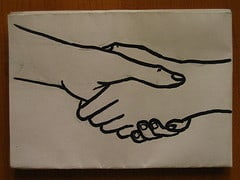
Interesting… I’ve always thought it’s common courtesy to *not* shake someone’s hand if you know you’re sick.  The only caveat I can think of is one outside the recruiting context — where, say, you’re sick and in a situation where you’re the most junior person in the room — and your boss barks out to the VIP some half-introduction and you’re expected to dive forward, shake VIP’s hand (with a firm, competent handshake!), and then recede back into the shadows to do all the work.  In that situation, it would break the flow of the half-second transaction for the sickee to inform the VIP and boss that s/he is sick, and really, at that point they deserve whatever they catch from you.*  (Pictured: Shaking Hands, originally uploaded to Flickr by Aidan Jones.)

But, like I said, that is usually not what happens in the recruiting context.  I agree, being on the receiving end can be a little awkward — but I usually just say “oh, thank you! feel better” and move on with the conversation.  If I really feel the need to make some sort of movement (because I’ve held my hand out too enthusiastically or whatever) I might do a slight bow, perhaps with both hands pressed together in front. But that’s just my $.02 — let’s hear from the readers.  First, we’ll take a poll from the sickee side of things:

How have you guys handled the situation from the other side of things?

* Apologies in advance if this attempt at humor has gone awry: I’m having an off day.

{ 72 comments }

Reader J writes in with a request for help on holiday cards…

I wonder whether you could post a very timely comment thread. I sat down, as I do every year, to address and send my holiday cards – only to realize that as a first-year attorney at a rather large firm that I had no idea who I should include on my mailing list. Likewise, I’ve accepted a clerkship in the relatively near future – would it be appropriate to send a card to the judge or to the chambers? I’m very curious to hear others’ thoughts on whom they include on their lists and why. When is it thoughtful to send a card to a higher-up, and when is it just kissing behind? :) How does one cull the list – it can’t be that one sends a card to every person one has ever worked with!

We sympathize — office politics are incredibly difficult to navigate come holiday-time.  First, we stand by our advice last year on how to address the letters, what kind of letters to pick, and so forth.  (Pictured:  New Year’s Fireworks, a pack of 8 available at MomaStore.org for $17.95.)

Secondly:  Of course you don’t have to send them to everyone you work with, the possible exception being when you’re the owner of a business.  But presumably, you would know everyone then — which is most likely not the case now.  For our $.02, we would build the co-worker card list as follows:

  1. Good friends who you also see outside of work.
  2. Your secretary (and her cash gift or gift card — our old poll on this (with lots of comments) is here…)
  3. Co-workers with whom you actively work — if you’re on a team of 50 people but directly report to 2 people, and work with another 3 people at your level, we would include those 5.
  4. Bosses who know your name, even if you only report to someone below them.  Ask yourself this question:  If this boss were to call you out of the blue to ask about some work assignment you’ve done, how odd would that be?  (On this point — we would send a card to your future judge.  The absence of a card certainly won’t be missed, but your best wishes for a happy year in 2010 are certainly not going to be seen as unprofessional.  In fact, you may want to send a card to the judge’s chambers, rather than to his or her home — that way the current clerk, the secretary, and everyone will appreciate your warmth.)
  5. Old mentors. If you worked with someone over your summer internship and liked them, send them a holiday card — even if you haven’t talked to them in a year.  It’s a good way to stay present in their minds — always useful for networking — and helps pave the way from “colleague” to “friend.”  You may even want to use the opportunity to casually suggest lunch.
  6. Also consider: Department-wide cards to essential departments in your company.  The mail room — the duplicating department — the library — they’ll all be happy you thought of them (and, hopefully, will remember it when you need something).  (You can probably interoffice these — every other card should be sent by mail.)

Cards and stamps are expensive, and hand-addressing them (both on the card and the envelope) takes time and energy — so don’t kill yourself on the project. At the end of the day, if you have to cut people, our first cut would be to the people who are at your level who you don’t know that well.  Try to remember who talks to who, also — the last thing you want is for Boss #1 to say to Boss #2, “Wasn’t J’s holiday card great?” and then Boss #2 to feel slighted because you didn’t send him or her one.

Readers, weigh in — are you doing holiday cards?  How do you figure out which co-workers to send them to?

(L-0)

{ 57 comments }

We just got this request in from a reader, and we thought we’d post it for the group to weigh in:

new problem:
an 8th year i.e. someone very much the boss of me (isn’t everyone?) just found me on facebook and wants to be added. i took a look at his profile and he’s friends with most of the senior associates and about half of the partners in our group. we are friendly and he’s a nice guy, but we are not actually friends.

i don’t know what to do. i like to keep facebook for just friends, so i don’t even add people that i am acquainted with, or people i used to know (like people from high school that i haven’t seen in years). but i don’t think that rejecting the invitation is a good idea considering that i am supposed to be trying to integrate myself into the group. and wouldn’t limited profile be obvious, like what am i trying to hide?

is this the end of my facebook? there’s nothing bad on there, but it is my personal space.

help!

Eeesh. We hate these decisions. We would probably accept him as a friend, but then our Facebook friends list has become overrun by former classmates from our Midwestern hometown who just discovered Facebook. (And boy, do they love to update their status.) In other words, we’re not really too picky about it — unlike LinkedIn, where we only link with people we could happily recommend to someone else. On the other hand, you could ignore him — if he asks about it later you could lie and say oh, I haven’t checked that e-mail account in ages, or “Oh, you know I saw that and then totally forgot about it” and let it go. We’d probably do the latter if we had an active dislike for this guy.

Readers, weigh in: what would you do? (Also, if anyone is so inclined, become a fan of Corporette on Facebook!)

{ 44 comments }

No, we’re neither Debrett’s nor Emily Post, but we know a thing or two about conducting ourselves properly at a business lunch… we’ve also seen some truly bad manners. Thus, whether you’ve been to a million business lunches or you’re just starting out, 10 Things You Should Know:

1. As soon as everyone at the table is seated, that napkin goes in your lap. If you need to get up at some point, the napkin should be folded and placed on your chair. (Not the table — no one likes to look at a dirty napkin.) At the very end of the meal, when everyone is finished eating, you should fold you napkin and put it beneath your plate, to the left. This holds true even if you’re eating at a diner with paper napkins.

2. Your water glass is to your right. Your bread dish is to your left. If you get confused, put your hands in your lap and touch the index finger of your left hand to your left thumb, and do the same with your right — your left hand should form a “b” (for BREAD) and your right hand should form a “d” (for DRINK). We’ve also heard to think “BMW”: bread, middle, water.

[click to continue…]

{ 44 comments }

Terms of Use; Privacy Policy