Networking

grandmother's report cardToday our friend W e-mailed us with a personal question:

So, my upcoming new job is seriously the first job I’ve ever had that I’m truly excited about. Obviously, I want to do well. I’ve never really cared about other jobs nor my performance in them. I realize this is totally cheesy and earnest, but any suggestions on some decent books in the “how to succeed” genre?

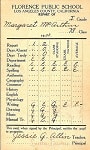
I dashed off a quick e-mail, recommending Why Good Girls Don’t Get Ahead… But Gutsy Girls Do: Nine Secrets Every Working Woman Must Know (which I read a zillion years ago and now looks like it’s out of print) as well as Getting Things Done: The Art of Stress-Free Productivity (seriously a great book),  promising to look for the post and thread where commenters listed a bunch of other good books, and reassuring W that she’ll be great.  (She will!)  Then I started thinking about it more, and with her permission thought I’d share her query here on the blog. (Pictured: grandmother’s report card, originally uploaded to Flickr by victoriabernal.)

The best advice I have, upon contemplating this for a few hours, is thus: treat your job as if you’re doing it for a grade. We all know that there’s a difference between when you want an A . . . and when a B+ is fine . . .  and when it’s a pass/fail class.  Sometimes, all you want to do is show up, keep your head down, and get your paycheck.  That’s working for a “pass.”  And it can be fine, for a little while — but in our experience that kind of daily existence feels hollow.

Other times, a B+ is fine — you know you’re doing better than most, and sure, you probably could be doing a lot better — but you’re juggling too much and right now, a B+ will have to do.

Then you’ve got your A game.  You go the extra distance, you engage on an real intellectual basis, and you strive to do better even if you’re already getting rave reviews.  You’re invested.  It’s the difference between training for a marathon and phoning in a daily workout.

For our friend, we would also recommend a few more steps:

1. Research.

  • Do some job-specific research:  Set up a Google Alert on your company, and if there are some superstars there that you’d like to work with / someday be, set up a Google Alert on them as well.
  • Do some career-specific research, by mining the Internet for the best sources for advice and news for your industry.  You want to be on top of the issues that will affect the way you do business — the new technology that will make it easier to do, the regulations and decisions that will make your business harder, and general “tips of the trade.”  If there’s a magazine or newsletter on point, subscribe; otherwise just be sure to regularly check the blogs (or set up an RSS feed).  You may want to see if your field is covered by SmartBrief, as recommended by venture capitalist Guy Kawasaki in a recent blog post.

2. Network. All that networking that you did to get the job?  Reach out to those people whose careers you admire, and see if you can take them out to lunch again — ask them for their best advice on how to succeed in the industry, what their path was, what mistakes they’ve made, and more.  (I might even say that your list should include people who you interviewed with — and connected with — even if you didn’t get the job.  Write them a personal e-mail, let them know where you landed, and see if you can take them out for lunch.  What is there to lose?)  In our experience, this is the best kind of networking — where you truly don’t want anything from them except for their advice.  If it feels like you’re aiming really high, ask them if you could chat with them on the phone for 10 or 15 minutes instead — everyone has time for a 15 minute phone call.

If you have time before your job starts to read some books, these have been recommended previously by commenters:

We either haven’t read these books, or haven’t read them all the way through, but we would also suggest that our friend W check out:

Readers, what are your best tips and tricks for succeeding at the office?

(L-7)

{ 37 comments }

Business lunchSummer is nearly upon us!  As law school, business school, and college  interns flood the workforce, calendars fill with networking lunches, team building meetings, and “get to know your coworkers” cocktail parties –  all with lots of food (and alcohol).  Reader A is particularly worried about the summer associate life in BigLaw:

I’m about to start a job as a summer associate at a Big Law firm. I’ve been told to expect daily lunches out, and been warned about the corresponding weight gain that usually happens. I’m particularly sensitive about not wanting to be the High Maintenance Associate–if I’m daily asking for “dressing on the side,” will I come off as obnoxious? Any tips for navigating the summer? Thanks.

This is a great question, because the summer can be a really difficult time for both those being recruited and those doing the recruiting.  We’ve talked about business lunch etiquette before, and we’ve also talked about trying to diet while working a corporate gig — but now let’s talk maintenance.  (Pictured:  Business lunch, originally uploaded to Flickr by Frederic della Faille.) Some tips:

- Follow an 80/20 rule. There are a lot of opportunities to overindulge during the summer, both at work-related events and non-work related events.  Do your best to follow a sensible, healthy diet about 80% of the time — and only aim for the steak frites / gourmet fried chicken / etc. entree about 20% of the time.  If you’re a heavy drinker, realize that most of your 20% choices will be in the alcohol field — there are a lot of liquid calories there.

- Seafood is your friend. Ounce per ounce, fish and shrimp have much lower calories than things like steak or red meat (leaner meats like chicken and turkey fall in the middle).  So long as you’re not ordering something fried, the seafood section of the menu should always be where you head first.  (Caveat:  salmon is on the fattier side — but it is filled with so many healthy Omega 3 oils and other benefits that we frequently eat it as a “splurge.”)  Watch out for rich sauces with butter or cream — and don’t be shy about ordering it on the side.  (We don’t think anyone will give you trouble for ordering things on the side — if you’re really sensitive,  perhaps try to make no more than 2 modification requests when you give your order.)

- Salads aren’t always the best bet for your meal. The dressing can be a problem, as noted by our reader, but other additions like croutons, nuts, hard-boiled eggs, avocado, and cheese can make salads extremely high calorie.  We recommend ordering the plainest salad option as your appetizer — most restaurants serve mixed greens — and it really should not be a problem to ask the waiter to put your dressing on the side.  (Here’s one of our favorite tips — ask for lemon juice on the side, and spritz it over the plain salad.  It’s good by itself, or — if you are having a bit of the dressing, it really makes the dressing “pop.”)

- At catered parties, try to be aware of how many hors d’oeuvres you’re eating. We’ve heard different rules for this — some people have a 3/1 rule, whereby they have to eat 3 healthy things for every 1 unhealthy thing they eat.  This author’s personal goal is to try to focus on the healthy foods (veggies, sushi, etc.) and only splurge on 3 really yummy hors d’oeuvres.

- Avoid drinks mixed with sugary liquids like tonic, juice, and liquors like triple sec. Instead of a vodka screwdriver, get a vodka soda.  (Soda has no calories.)  Or, better yet, stick with wine or beer.  It is in your best interest to avoid getting drunk at a work event, for more reasons than we can count.

- Finally:  Pay attention if your clothes are getting tighter. We like to use our jeans as a sign for when it’s time to cut back, but a particular belt, pair of pants, a sheath dress, or even a button-front shirt can be a gauge.  The trick is to wear them frequently enough (or at least try them on) that you notice.  (And, dear readers, bad news:  if your sheets still fit on the bed, the dryer is not shrinking your clothes.)

Those are our top tips — readers, what are yours?

{ 92 comments }

Today, reader D wonders which professional organizations she should join…

My firm expects/requires us to join a professional organization, which presumably leads to networking which eventually leads to clients. Some attorneys are members of the Bar Association relevant to their practice area. The top female attorney in my group is in the Junior League. Another is a member of the city’s business development group. I’m not sure how to find what organizations are out there, and what the right way to evaluate those options is. Whether to go for a more women-centric one? A practice group focused one? Help! I wonder what other Corporette followers are part of.

This is a great question on so many levels.  First, just wondering which organizations to join is an excellent networking question – this author’s tactic when I was really junior was to send a brief email to everyone I admired and ask which organizations they had found to be worth their time.  I wound up e-mailing 4 or 5 people individually (mostly superiors at the office), but this is also a great opportunity to ask former professors, former classmates, and perhaps even alums from your school.  It’s a simple, brief e-mail to write, and it shows a bunch of different good things about you:  first, that you’re ambitious; second, that you admire them/trust their opinion (in an ever-so-slight, non-fawning way), and three, if you’re smart in how you phrase the e-mail, it puts you on their radar as being particularly interested in “X” and being willing to spend non-office time on it.  For me it was First Amendment and intellectual property issues; for you it may be women’s issues or something like that.  A tip: Be sure to ask both about which organizations to join, as well as if there are any special groups within the organization worth focusing on.  (Another great question for this crowd:  What are they reading, professionally?)

After you get some suggestions, weigh the different options. Is the time commitment doable?  Is there a fee to join, and  a) will you company reimburse you, and if not, b) can you otherwise write it off as a networking (or charity) expense, or c) can you otherwise swing it? Will you feel like your time and money is being well spent — will you be doing good works?  Listening to great seminars?  Having really intellectual discussions?  Once you do join, we’d suggest reassessing those factors fairly often — there are a lot of groups to join, and limited time to spend on networking.  (And, we’d suggest repeating the initial exercise once you’ve joined — ask people from the organization you joined what other organizations they’ve been a part of.  It’s a great ice-breaker question.)

Readers, which organizations are you a part of?  What factors led you to join them?

Pictured above: 3D Reality Handshake, originally uploaded to Flickr by lumaxart

(L-0)

{ 83 comments }

Our first thought when we got this request was, “garsh, these times we live in!” followed by, “of course, we will all be doing these very soon”…

Help! I am a 1L interviewing for summer associate position and the firm has decided to do a skype interview. I am terrified I will look washed out/ too made up/ etc on camera. Any tips for hair/makeup? Also, my career service office recommended wearing a nice blouse, but I feel a suit would be more appropriate.

Wow. Ok. We’ve only used Skype a few times (on our Mac laptop, primarily) to talk to a bestie who lives in London.  From our limited experiences with Skype, we would have to say:  it does not seem to be the most flattering. You don’t know where to look, because you want to see the screen and see what they’re doing, but you should be looking at the camera, and nothing is eye level, and it’s all very weird.  (Pictured:  nick skype, originally uploaded to Flickr by nedrichards.)

Some tips:

1) Download the program NOW, if you haven’t before.  Start playing around with it.  You may even want to see if there’s a way to record yourself talking on Skype (or talking on the other end of Skype) so you can practice — really practice — where to look and how to do it.  Make sure your sound is good, make sure your Internet connection is good. Our guess is that your computer should be nearly eye level in order to do this.

2)  Make sure everything about the call is professional. What’s your username?  If possible get something resembling your e-mail address (even if it has a random number after it) — there are no points for creativity.  Next, look around the room where you’ll be interviewing.  If there’s a blank wall behind you, fine.  If it’s your giant poster of Robert Patterson, you might want to find another locale.  Given our choice, we’d go with a bookcase behind us, but really, just make sure there’s nothing that could be misunderstood as reflecting poorly on your personality or character.  We’d also make sure that if you have any roommates (or a significant other, or kids, or even pets) that you barricade yourself inside a room, perhaps with a sign on the door about how you’re in the midst of a telephone interview and appreciate silence.  (Turn off the ringer on your landline, if you have one, and the ringer on your cellphone, if you use one.)

2) We’d wear a full suit. It will get you in the “interviewing” mindset, and will help you feel more professional during the interview.  In this About.com article on video interviewing, the Tech Expert for Skype recommends avoiding patterns unless you’re sure how they’ll look (dots look worse than stripes) and staying away from bright colors (sky blue looks great, but red/hot pink don’t look so hot). You could just do the top half of the suit (we’re sure we remember some comedic anchor joking about only wearing boxers during the newscast) but this could work against you — you might have to walk across the room to get something.  Play it safe; it’s an interview.

3) For makeup, we would advise paying attention to undereye circles, flyaways, acne, and so forth. We’re a bit surprised to see the advice from the Skype expert, suggesting women wear “high-definition foundation (creating soft-focus effect in any kind of lighting), blu ray high-definition matifier (refines lines, minimizes pores for a polished look) and blu ray high-definition lip gloss (for a high shine, plumping effect)” — perhaps this is the world to come?  As luck would have it, Sephora has a lot of those things on sale right now from the CARGO line of products — for example, this bronzer is $15 from $30 (CARGO blu_ray™ Bronzer Medium Matte).  Not on sale, but also fits the bill: this HD foundation from MakeUp Forever (the primer, MAKE UP FOR EVER HD Microperfecting Primer 0 Neutral, is $32, and the foundation, MAKE UP FOR EVER HD Invisible Cover Foundation 115 Ivory, is $40). The concealer from the same line is $28 (MAKE UP FOR EVER HD Invisible Cover Concealer 315 Ivory).

4) Finally, focus on your posture. Because you’re in your own house you may feel more at home — don’t; this is still an interview.  You might also want to be wary of awkward pauses in the interview, when you might be tempted to fidget, look bored, or allow yourself to be distracted (as you might during a pause in a telephone conversation). You’re still on camera; act as if you’re sitting in that person’s office.

Readers, please weigh in (particularly if you’ve interviewed someone via Skype!)…

(L-4)

{ 30 comments }

We got this request in over the weekend, and had to weigh in…

I’m a 2L in law school and going to a job fair next weekend, where I have a few interviews. Since getting the interviews and I have been in touch with a friend of a friend who is well connected, and who has called one of my interviewers on my behalf. She mentioned that the interviewer would like to go to lunch with me and herself around the date of my interview, so here is my question: if it is the day of my interview, I’ll be in a suit obviously, but if it is before, what would I wear? the lunch would be the first impression, so my instinct would be suit, but that seems formal for a lunch. Thanks for any advice you can give!

Congratulations — this sounds like a great opportunity. We agree that a suit is probably the thing to wear, but thought we’d temper it with a few other thoughts:

  • Where does this job rank on your wishlist? If it’s the number one job you want, bust out your best interview suit. If it’s lower on your wishlist, consider wearing your second-best suit — particularly if the lunch is the day before the job fair (that way, if you spill something on your second-best suit, you still have your power suit to wear to the job fair).
  • Consider the context — how senior is your friend who set up the interview? How senior is her friend, the interviewer? Where are you meeting? The more formal the spot (and, yes, the more senior your companions), wear a suit.  On the other hand, if they’re recent graduates and you’re meeting at a trendy or casual spot, you might want to opt in favor of a more casual suit-like outfit (i.e., blazer, trousers, button-front shirt, etc.).

We would suggest treating this luncheon like the interview — read everything on the company’s web site, and any other materials you can get your hands on.  Hunt online to see what people really think about working at the company — particularly if there’s a swarm of bad reviews, you may want to use this lunch to tactfully ask questions of the interviewer and try to determine the truth of the situation.  (Be warned that it’s generally better to save the  “but how would *I* like the job” questions until after you have the offer in hand — but a few well-worded questions can provide insight.)  At the same time, don’t be afraid to toot your own horn at lunch, and, particularly, to show the personality traits that make you a great employee / team member (or have stories ready to tell that illustrate those traits, should the opportunity arise).

Our other advice would be to try to pay particular attention to details about the interviewer, and mention them later in a friendly (not creepy!) way.  For example, if she regales you with her adventures while trying to prepare for an upcoming dinner party, wish her luck with it at your interview the next day, or in your thank-you letter.  (Do NOT mention it both times; that gets into the creepy territory.) Finally, you may want to check out our previous tips on the business lunch.

Readers, what are your thoughts?

(Pictured, above:  Business lunch, originally uploaded to Flickr by Frederic Della Faile.)

(L-0)

{ 61 comments }

Reader A writes in with an urgent request…

I sent in my cover letter + resume to a firm and was invited to a dinner with potentially 2+ members of the student hiring committee (I’m assuming other students were invited as well…) the restaurant is quite high end and I was wondering what recommendations you would have to wear. They didn’t mention a dress code. I’m thinking either: 1) A black dress + Black jacket OR 2) Black dress pants + dress shirt + black sweater over it.  What would be your choice?

Ultimately, this is an interview, and that means one thing to us:  full suit. Because it’s unclear, though, be prepared for the possibility that you will want to take off your jacket to be more casual.  So, for example, choose a suit where you like the pants by themselves, and choose a layer beneath the suit that has sleeves and looks professional.  A silk sweater would probably be our choice here, accessorized with pearls or other conservative (and good) jewelry.  (Pictured above:  August Silk Three-Quarter Sleeve Square Neck Sweater, available at Macy’s for $29.98 — we’d also recommend checking out your local Filene’s, TJ Maxx, or other discount store; for some reason they frequently have a wide variety of these silk sweaters.)

And yes, we did say pants — even though we’re normally huge fans of the skirt suit for interviews, because this is dinner, you want to avoid any appearance that you thought you were going on a date.  Go with a skirt if you want; we’d avoid a dress at all costs.

Readers, what say you? Also, do you have any other tips for the tricky dinner interview? We’ll point you to an older post we wrote about dining etiquette; we’d also advise drinking very little (one glass of wine at most) and ordering something easy to eat, like ravioli.

{ 35 comments }

Terms of Use; Privacy Policy