
Weekend Open Thread
This post may contain affiliate links and Corporette® may earn commissions for purchases made through links in this post. As an Amazon Associate, I earn from qualifying purchases.
Something on your mind? Chat about it here.
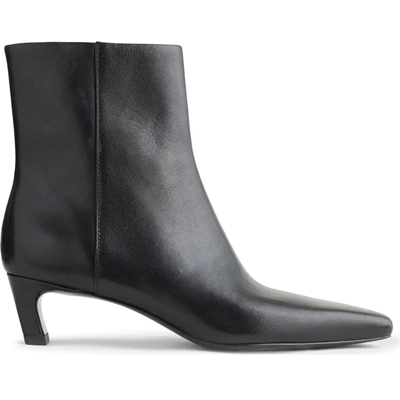
If you’re looking for sleek boots with an extremely low heel, these best-selling boots from Madewell may fit the bill.
I almost never wear heels at this point, but when I do they really, really have to be under 2″… so these 1.75″ heels look great. I like the kitten heel itself, also, which looks sturdier than a stiletto kitten heel. (Weren’t we calling these “banana heels” a few years ago? Off to Google…)
Madewell apparently has a custom padding (MWL Cloudlift Lite padding) that “makes it feel like you’re walking on a . . . well, you know.” It’s also nice that the leather was sourced from a tannery that was certificed by the Leather Working Group.
The ankle boots come in four colors (black, brown, oxblood, and brown suede); there is also a knee-high version available. Boots are $218-$298 at Madewell and Nordstrom.
Sales of note for 11/6:
- Nordstrom – Early Black Friday sale! Up to 25% off fashion + 15% off all fragrance
- Sephora – Savings Event! 10-20% off for members, and 30% off Sephora Collection
- Ann Taylor – 25% off your purchase, and $50 off $200
- Brooklinen – Surprise weekend sale, 20% off
- Electric Picks – 25% off
- J.Crew – 2400+ markdowns
- J.Crew Factory – Extra 50% off clearance
- M.M.LaFleur – Save 20% on suiting and dresses! Try code CORPORETTE15 for 15% off on other items)
- Talbots – Enjoy 30% off your entire purchase


Do you feel that your education “paid off” for you?
I grew up in an immigrant family. School was always the most important thing, the whole 9 yards. I went to a top 50 undergrad, majored in something I was interested in but also my family really approved of. After undergrad I worked in big 4 consulting but hated it and soon after went to a top 10 grad school for a program that my family didn’t love but didn’t hate.
And I have to say, it’s all worked out really well. The grad program was a perfect fit and actually matches what I do today well. The undergrad major isn’t as relevant, but its still a good background. The big 4 job is still useful to name drop even though I’m in an unrelated field – it gives me gravitas. So even though I’m not a lawyer/doctor/engineer, the whole path and approach really worked out for me.
Nowadays I see a lot of the postgrad education isn’t crucial, the pedigree of your college doesn’t matter etc and I see where people are coing from but it doesn’t match my experience at all.
Yes. I was a kid from an on-paper upper middle class family, but really middle class in lifestyle and upbringing. My mom was SAH who went to typing school after high school, my dad was a sales guy with a college degree but from a satellite state school type place. We were a heavily couponing household with little brand name stuff, very conservative vacations etc. but a home in a really nice school district and my dad’s income was in the lower part of the upper middle class bucket.
I went to a fancy highly rated SLAC where I not only met my husband, but I made connections that really helped me decide on a career path (grad school and then a good job). We got some financial aid for my college- at first we didn’t get much but then my dad was laid off during my time there and the college stepped up to keep me there. I also took out loans and graduated with about $40k in debt in the early aughts. I went to grad school for mostly free and while I don’t do anything related to my grad program now in my mid 40s, grad school got me into my first job in my current career path. Again, it was the connections! One of my grad professors personally knew the hiring manager at the job I applied for (I think their kids played sports together or they were neighbors or something) and got me to the top of the interview pile.
My husband has basically the same story- he did undergrad and grad and in both situations got his job due to connections made at school.
Finally, my oldest is looking at colleges and she’s all but a shoe-in at our alma mater because she’s a good student that falls in their target acceptances, a double legacy, and an athlete they want for their pretty competitive D3 team. I’m not sure she will end up there but it’s really nice to have that as a known option.
Yes 1000%. I wouldn’t be where I am today without Wellesley
Yes, but it took time. I also grew up in an immigrant, low-income family. I went to top-ranked undergrad and law schools and then graduated right into the Great Recession and was laid off within months of starting my first job. And then it took me quite a while to find my professional footing, but I eventually did…and lo these many years later, I’m so happy with how my career has turned out, and very very grateful for the socioeconomic and class mobility that it has provided. I don’t take it for granted at all, both because I didn’t grow up with it and because of setbacks earlier in my career.
My undergrad, not so much (top 35 school at the time but I didn’t choose the right major), but for grad school, I was more strategic and selected a top public school that gave me my master’s (in public health) for $25K out of pocket. The combination of in-state tuition and tuition remission for on-campus research positions made it FAR more affordable than it would have been at any private school and it was still one of the top programs in the country. I know myself and that I would have regretted paying $100K or more for a degree with lower earning potential.
I do think going wherever is reasonable for undergrad and then a top grad school is a good combination. And people look most at your most recent degree.
I feel like people do the opposite through. Top undergrad and then local grad school where they live. I think that law and MBA schools are maybe different though if you are at a top school vs just a good school.
Yes it did for sure, but I’m older Gen X and that college degree was my only way to enter the “professional” world at the time.
I was a rural, poor, full financial aid kid, so I’ve been grateful for the opportunity for my entire life. My lifestyle now is a lot different than what I grew up with, and very different from my similar aged family members who didn’t go to college.
Yep. Education has actually made a difference for every member of my family who pursued it. I know it’s not a magic bullet but its been pretty close to one. Or at least a better set up than not.
Poor rural kids with no college in their background do OK also if they go to State U and get any degree and use it in their field — e.g., education degree with teaching credentials. A job like that tends to come with good health insurance and some sort of retirement (maybe even a pension). It’s a predictable middle-class life, often with minimal debt.
What’s bad is going to school and not finishing or getting a degree that you don’t use. The higher up the food chain you go, people don’t fail to finish, but I am convinced that the struggle I see with my community college friends isn’t lack of ability but acute lack of funds + lack of parental funding. Even for my friends who grew up comfortable, a parental divorce often put college out of their reach and they began a combo of working + trying to also juggle cheap local school options.
My neighbor grew up poor and went to Harvard so long ago that they had poor first-generation kids taking out loans. She paid off her loans later in life (because daycare had no payment plan) and it seems that while Harvard helped her, she would likely have done well anywhere. And with $$$ loans, her success it came at a tremendous personal cost. I’m glad that schools with huge endowments don’t seem to run that way for kids of lesser means now. Her kids are going to good schools where they will graduate debt-free and that drove the family’s thinking.
“My neighbor grew up poor and went to Harvard so long ago that they had poor first-generation kids taking out loans.”
This is why I went to a UC school instead….
this is why I went to a UC school instead of something more “prestigious”
My education is the only reason I am where I am today. I do patent litigation at a small firm. I was an equity partner at a V20 before that. I got an engineering degree and law degree from the two top UC schools. I’m the first person in my family to graduate high school and speak English. My family was a low-income immigrant family. It is a lot harder to have the right doors opened without a prestigious education if you come from a background like that.
yes and no. My fancy undergrad impressed law schools and I got a merit scholarship that changed the course of our lives financially (thanks to the power of compound interest, it had a much larger impact that the total scholarship amount of $75k would suggest).
However I left Big Law fairly early to follow my husband’s career and then eventually left law altogether and now live in a small Midwest city where fancy schools don’t carry a lot of weight. If anything the big state schools have stronger networks here.
Where in your (online) life are you using passkeys? Face ID? Dual authentication? Other higher stuff?
I’m most wary of using Face ID for banking. I don’t totally understand passkeys and don’t want to have a problem switching between different devices. I’m only using dual authentication 2 places so far but it’s easy enough with the app Duo.
I don’t use Face ID because I don’t want it enabled on my phone. Part of this is that I travel a lot. I really only use passkeys at work. I use dual authentication for banking accounts.
Why is Face ID contraindicated due to travel? Earnest question.
In airports they could technically hold your phone up to your face and unlock things that way. If you refuse to provide the code and Face ID isn’t on that is more secure. I travel outside of the US for work a lot too so its relevant differently in different countries.
I don’t use Face ID for financial-related apps because I don’t want anyone to be able to grab my phone, wave it at my face, and get access.
No Face ID, don’t use passkeys and don’t use dual authentication for most stuff but I do for my bank accounts.
I’m late to the game this morning, but the tartan blouse made me wonder. How many of you keep a holiday wardrobe
I’ve lost some weight over the last few years (no magic tricks, good old diet and exercise, unfortunately) and have had to basically replenish my wardrobe from scratch.
I have a small closet and rotate warm weather vs cool weather clothing seasonally, but other than that I don’t really have “holiday season” clothing.
I used to be invited to a formal work related Christmas party every year and had what I’d call a capsule for that, but those parties seem to have gone the way of the dinosaur.
I was thinking this morning’s blouse was cute, but realistically, how many times would I actually wear it? For one more casual gathering? I can’t imagine wearing it more than once or twice ever.
What do you have in your closet for holidays?
I have a whole rotation of holiday clothes. Three skirts, a handful of shirts, and a couple of dresses. Some of them can be worn non-holiday too. I get plenty of wear out of them each year and I’ve had them forever.
Every year I think it would be fun to do this, and then I’m like, “but I’ll wear them twice before they go out of style!” so I don’t. I just wear regular clothes in various degrees of dressiness.
I find that things like this are in style much longer than one would think.
I live somewhere with four seasons, and that blouse would just be a winter blouse for me, not a holiday blouse. I wouldn’t save it for a holiday occasion. I always have some seasonal items that I know would be fine for a holiday occasion, but they’re also just weather appropriate in a seasonal palette so they see plenty of use.
I have a burgundy velvet blazer, a black satin pleated midi skirt, a sparkly black sweater, a burgundy satin bias-cut midi skirt and a matching burgundy sweater. I hope nobody remembers that I rewear these pieces in various combos.
OH! And two velvet button-downs I only wear in December. I love them.
I have some beautiful vintage Fair Isle sweaters passed down from family. That’s it and that’s all I want!
Not much. One sweater with some metallic thread, a silky Stewart plaid shell, and a matte satin blazer.
I need to improve how I delegate and how I accept/take in delegated work. This year, I read “If you want it done right, you don’t have to do it yourself” and it has shifted my entire work life. I want to add more in ’27. Any other really good delegation resources, with specific examples or resources or workflows, that you have used and like? Open to books, podcasts, worksheets, a good blog post – you name it.
My foot is apparently an odd shape: too wide for normal shoes, too narrow for wide-width. Example: cole haan, naturalizer. Their normal shoes are too narrow around the ball of my foot. I step out of their wide width and develop blisters along the sides of my feet/toes as they move around in the shoe. I can solve some of this with a wide width and extremely thick socks, but that only works during some seasons. Any solutions?
They say actually most women have this foot shape, so it’s a pretty common challenge! Some people turn to brands like Dansko that are designed for heel slip. Some people turn to various kinds of boot and bootie.
I think maybe that’s just CH and Naturalizer? Or maybe I have the same foot as you. I’ve almost never been able to wear CH, which makes me sad because some of their shoes are cute, and I have a store near me. I made the mistake of wearing a brand new pair of beautiful olive green suede Naturalizers (my first Naturalizers in a very long time) to a conference recently. I didn’t even walk much, but within a couple of hours, i wanted to throw those shoes out the window. My left fourth toe was killing me. Now I can barely stand to see those shoes in my closet, but I’ve added Naturalizers to my no-go list. (I don’t have issues with other brands.)
What would you ask for from a new biglaw firm as a lateral partner coming in to build up a new practice group? A guarantee? Budget for hires? marketing budget?