
Splurge Monday’s Workwear Report: Fida Knit Cardigan
This post may contain affiliate links and Corporette® may earn commissions for purchases made through links in this post. As an Amazon Associate, I earn from qualifying purchases.
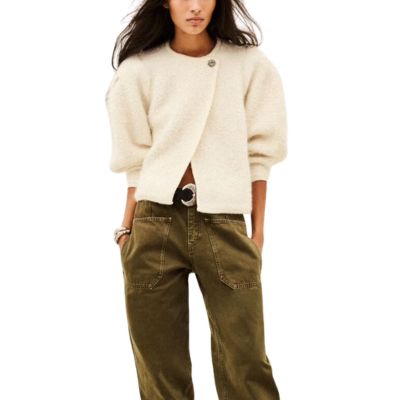
Our daily workwear reports suggest one piece of work-appropriate attire in a range of prices.
This sweater from ba&sh is a fun twist on your typical cardigan. I like the one-button look and faux fur effect that the knit gives. I would wear something like this on a day when I was stuck behind my desk reviewing documents but wanted to look a little fashionable while cocooning.
It is dry clean only, so buyer beware, but I think it’s worth a few trips to the dry cleaner for something so fabulous.
The sweater is $485 at ba&sh and comes in sizes XS-L.
Sales of note for 10/16
- Ann Taylor – 50% off + free shipping on everything!
- Brooklinen – Friends & Family – 20% off sitewide and 50% off select bundles
- J.Crew – Extra 50% off 3+ sale styles with code – includes lots of suiting, sweaters, and pants
- J.Crew Factory – Friends & Family, extra 15% off your purchase
- M.M.LaFleur – October Sale Event, best prices of the season (Try code CORPORETTE15 for 15% off on other items)
- Nordstrom – 5840+ new markdowns for women, up to 40% off
- Talbots – Friends and family, 30% off your entire purchase
- Theory – End of season sale is on with extra savings (new prices are marked)


Words of encouragement needed: I gave notice at my stressful job in my late 50s with nothing lined up yet. I’m very burned out from caregiving plus this job, and need to take some personal time. Finances aren’t an issue. I’m feeling very unmoored, even though I made the decision after weighing it for some time. I’ll likely consider contract work in the future, but I still can’t get past the feeling I’ve “retired” and that I’m not successful if I’m not in my successful career. Anyone who has been though this please chime in with how it went for you!
Take a few months to adjust, catch up on sleep, and go through all of the health issues that always crop up after a stressful period. Then figure out what’s next!
You’re lucky not to have to worry about finances while caretaking.
Maybe lean into that when you think about what you have to do vs what you want to do.
Are your finances sufficient to be retired? If so, why not just be retired, possibly with some contract work on the side, and consider it a win? Even if you do still need to work some, getting to the point where finances aren’t an issue is success!
+1
This is where I landed. I haven’t told people I am retired yet, and many are still asking me when I am going back to work. But I have started telling the nosey acquaintances that I will do some consulting part time. I don’t tell them that I am consulting with myself, to optimize my investments and my life. My parents also passed recently so there is a lot to do, although the caregiving has ended. I am filled with mixed feelings of sadness, and relief.
Most people I know are planning to retire in their late 50s/early 60s, why not just go with that since your finances are fine?
Medicare eligibility may put a dent in this. IIRC most places don’t do retiree medical at all, much less for early retirees.
It’s still just a time period you bridge and people do that by planning.
Buuuut if you’ve already quit a job, you are into just paying market rates each month or hoping nothing happens? Is long-term COBRA an affordable option (and for several years running)?
Presumably if OP says finances are not an issue for the foreseeable future, they’ve budgeted for health insurance
Or live in a country where you don’t have to put up with this nonsense.
i’m confused – isn’t the marketplace always an option?
It is, but it is wildly expensive. I am paying $1600 per month at age 57 just for premiums, and it is rapidly increasing in price each year and with increased age. You really have to plan carefully. And in general, I have found Cobra to be cheaper and much better coverage than ACA plans, for the cost.
Remember that when each of us get to the end of our lives, none of us will wish we had worked more. Take the time you need to be your best self, spend time with the people who matter, and love your life. As a stranger on the internet, I’m truly excited for you! This has potential to be a really wonderful season of your life. You have a lot of freedom and flexibility: Think about what you want, what brings you joy, and have at it!
I say this kindly, it is almost impossible to be hired in your mid to late 50’s. I know unfortunately from experience. Most likely this decision is already made for you. Grab consulting work where you can.
OP here: Oh definitely, I got the current job at 54 and felt lucky to get it. If I wanted another full time corporate role, I wouldn’t have left. There’s a decent need for consulting work in my industry and with my background. The money part is not crucial but of course a little extra money is always nice.
the unmoored feeling is entirely normal: you ARE unmoored. Your job — stressful as it has been — provided structure and a clear pass/fail for your life. You no longer have that, so you’re going to feel the gap. It will take lots of time merely to get rested enough.
Would it help to look at first six months of no-job as a sabbatical? A time devoted to rest, refreshment, regrouping, etc.
Also, the more years you have spent using career success as a goal, the more unmoored you will feel when you remove that benchmark from your identity. Without a career, who are you, and how will you know if you’re a success? It’s a huge question, but it WILL sort itself out.
Congratulations on giving notice and leaving a stressful job! You should be proud of yourself for setting that boundary. Enjoy your freedom. It will take at least 6 months just to catch up on all the sleep you’ve missed. I’m in my late 50s too and am done working after completing a successful, identity-defining career. It took a while to get used to having so much free time, Believe me, that feeling will pass and you will find plenty of things to do. I have leaned into a hobby that I never had time for before and now I finally get regular exercise. It helped me to say that I completed a great career (rather than abandoning it or giving it up). I have also never liked the word “retired” because of the image it conjures up (unjustifiably) of someone who sits around the house all day in front of the tv. I use the term “gone independent.” I’ve finished my career and gone independent and it feels amazing! Give yourself time to adjust once you actually stop working and you may surprise yourself by not missing work at all.
If you’re going to take contract work, you’re not retired. I would follow the recommendations for rest/planned time off. And then set out the process of fractional or consulting work that suits you if you still want to do work. You could just have 1 client and work a handful of hours a month if that is what is meaningful to you. I do agree that a job doesn’t define you, but if you want to work at a limited capacity, start an LLC and do that.
Good for you! I can understand how hard this must have been but you made this leap and that is admirable! Good luck with your next step.
There’s a lot written about how you need something to “retire into.” For you that may be consulting, but it may be doubling down on a hobby or charity. Look at this as the beginning to the next 20 years and try to make great habits now — exercise regularly and fit planned social interaction into your days as much as possible.
I’d also say to plan a big trip if your caregiving duties allow it.
Love the sweater. Will have to wait for a sale. Ultra low stakes question- What kind of boots are in style this fall to wear with skirts? Slouchy or sleek? Block heel, stiletto or kitten heel? Suede or leather? Looking for narrow calf styles since thats the only thin part of me. TIA
Sleek and low block heel are timeless. Leather is more versatile to dress up/dress down. I would go with a riding boot that fits well and flatters.
I have a promotion coming up and my office does an evening party after work to honor those promoted. Any ideas for an outfit that fits the occasion? Everyone will be coming from work so it will range from business casual to business. I would prefer pants and some sort of jacket because I am always cold. TIA!
How fancy a party and what is your budget? I would go get that black blazer with the gold embroidery/decoration that was featured here recently.
Since some people will be casual, I would be cautious about being too dressy. Since it’s evening, I would wear aatin skirt or pants and a high quality sweater in the same color. Choose a color that really flatters you (for me that’s a peacock blue or gray blue. I could see someone with warm coloring rocking a rich brown).
I disagree with the satin pants suggestion for this. That’s a cute look for dinner out with friends.
I’d go with tweedy pants and a The Fold top, budget permitting. Their tops are structured and thick so have the warmth and vibe of a jacket.
I’d wear black pants and take a cool blazer with me to change into for the party, something colorful or with a pattern or even sparkle – you know best what the vibe is at your office.
Alternatively, I think the “column of color” in navy, dark grey, dark green or any other saturated color might look very nice, especially when paired with interesting jewelry. To me, that would mean pants, shirt and a blazer or jacket in the same color/hue.
For warmth, you could also opt for an elegant silk scarf or pashmina, maybe with a pattern?
Wouldn’t do the “column” in black personally, but you know your colors best.
I would not wear a whole different outfit like a dress, given that colleagues will be coming from work.
Congrats on the promotion!
Since it sounds like everyone comes from work, I would wear your favorite work outfit. If you want something new, take this opportunity to get a new blazer you can rewear in the office.
+1. I was thinking the exact same thing!
Has anyone gained weight just in their stomach area and lost it? Not fibroids and I’m 50+. It’s so frustrating because with older kids about to drive I may get back some free time soon to go to the gym, but I don’t need to lose weight vs just tone up. I miss my clothes (after pulling the cozy fall ones out of storage). Help!
Yes, but I did have to go low carb. It wasn’t really a gym/toning issue for me.
Welcome to menopause arrgh. Try pilates, legnthening exercizes have really helped me. I use Mari Windsor or Ana Caban on utube. 15-20 minutes.
I did but was 100% diet. No carbs or alcohol and it vanished.
Sigh, this again. Yes, almost everyone does. It’s also probably not just in one area, those are lies we tell ourselves. There are lots of options for handling this today.
Eh, if the belly is the first place you gain weight then if you lose the weight you lose the belly.
I feel like I would just lose my already small bust area and keep it everywhere else.
Yes. It’s menopause. The only way I was able to reduce the belly was losing weight and the only way I am able to lose weight is a GLP1. It does not make it go away but it reduces it so at least I don’t look pregnant.
This.
What if you are already pretty thin? I don’t want to look like some of the thin celebrities who I guess are on GLPs or lose muscle or risk osteoporosis. I’d love to reshape my shape, but at 130 pounds, feel that I need to fix this at the gym or through lifestyle. I get that many people have health benefits but I’d worry more about unintended consequences.
It still works for that and has many benefits.
I have this exact issue. I weigh 100 pounds and just the 5ish pounds I have gained are in my stomach area and it does not look good. I don’t need to lose weight generally but after decades of having a flat stomach it is so weird that I have this huge pouch now – ugh
11:03, same but I do a low dose GLP1 and it fixed this entirely.
Even 5 or 10 lbs made a difference in my tummy, so it doesn’t necessarily have to be like 30 lbs or 50 lbs….
I think the question is whether it’s visceral fat which has different health implications.
I’m the one who had to go low carb, and I really wonder if GLP1 is a healthier option than limiting diet that way.
I’d say yes, absolutely. Restricted diets are just disordered eating that leave you with nutrient vacuums you don’t get in a GLP1.
Do you honestly think people don’t combine eating disorders and GLP1 use? Lol
Well I don’t leave myself with nutrient vacuums (that’s entirely unnecessary; I know what RDAs are and how to hit them!). I also don’t think I have disordered eating presently (stabilizing blood sugar and insulin really helped my relationship with eating compared to overwhelming cravings, hangriness, etc. when those were unstable!). And people on GLP1s have to be careful to eat enough and hit nutritional targets anyway, right?
I was thinking of things more like CVD and long term outcomes.
This is just so false. I have insulin resistance and eat low refined carb and do not have any nutrient deficits. The standard modern diet is awful and it’s possible to make changes without being disordered.
I get that a lot of people recommend this and I am not a doctor… but if you only have a bit to lose I’m just curious what else you have tried that has not worked. I work out 5 days per week and when my weight goes up more than I want (and I am convinced it is not muscle gain) I track calories for a few weeks. I use an app that tracks macros so I still eat a balanced diet and get the nutrients I need. This works great for small amounts of weight loss without losing muscle or locking me into expensive medications for the rest of my life. I resisted tracking for along time because it felt “extreme” but it is honestly super easy and the numbers don’t lie. If you maintain a deficit, you will lose.
Calorie counting can lock people into calorie counting too though if the result is lower metabolism. I’m not sure that’s really healthier long run. I also get so fatigued I can barely move if my calories are low.
You should go the gym and lift weights. It might or might not help with your weight distribution but it’s still important. You can take a glp-1 or try to lose weight another way but none of us can guarantee that it will come off of your stomach first. I think surgery is the only successful solution for spot reduction. A friend is a plastic surgeon and I had no idea how many “regular” women get liposuction. It’s a lot more than I thought. This is not to encourage or discourage you from it but if you’re thinking flat bellied ladies your age have discovered a secret you haven’t it might be that.
PSA that if you ask anyone online about weight these days you are going to get some extremely bad advice to risk your health on drugs you get online with inadequate supervision. I would start with a scan to assess your body fat and lean muscle mass, and then work with a trainer to see what you can do through leaning in on the right mix of exercises.
If the scan show that there’s a lot of fat on the liver though, I’d go straight back to a physician.
Not medical advice, but I started using red light therapy regularly and the tummy went away. No change in diet and I was already exercising daily. I’m late 40s.
What shoes or footwear are we wearing with wide leg pants of regular length? And what if they are cropped? Summer was a mix of flats and fashion sneakers with no-show socks but I want something for work and my feet and ankles aren’t happy if they are cold.
My default of cowboy boots to my eye looks good for bootcut denim but I’m not sure re full-length tweed, wool, or corduroy pants.
My feet are usually warmer indoors in winter than indoors in summer thanks to AC. I usually just wear hose-weight socks with my flats or heels, or sleek booties. For commuting I wear warm boots and then switch out inside.
I’m still wearing lug-sole boots. I find that a higher shaft looks good with wide, cropped pants.
I have jcrew ankle booties that I wear. They change the style slightly every year but they’re comfortable boots that look a little more polished.
If you like cowboy boots, have you tried the pants with shorties or barn boots? I find those work better under dress pants since the fabric doesn’t get caught on the shaft of my taller boots. I live in Texas which could cloud my judgment but cowboy boots with dress pants is totally workable.
Puppy incoming! 10 week old Australian labradoodle comes home with us on the 30th. This is my first true puppy (prior dog was a rescue and she was approx 1 when we got her. She came to us crate and house trained).
Give me all your tips? Going in a little blind but I have two weeks! The breeder has given us all the info on food and whatnot so I’m not worried about that. If you have tips for house training or anything else, I’ll take it!! I have two kids – 8 and 3. We work out of the house but have a nanny at home who is a very experienced dog/puppy owner and is fully onboard to help. We have a medium sized home in the suburbs with a fenced in yard, hardwood floors and gates still up from our last dog, so we have that part covered.
Help! No regrets but slightly overwhelmed!!
Remember it will pass and the first few weeks will be insane. Clear your schedule as much as you can to account for that. Plan to sleep with you pup on the first night, crate training can follow but that first evening is scary for them. We had success with a playpen and pads for those first weeks of needing to keep them contained, also baby gates, all the baby gates, and an outdoor pen for going potty. Take the dog everywhere when he’s a puppy too, socialization now is key to an easy dog later.
Yes to socializing but first, check with your vet that your puppy has had sufficient immunizations to allow for mixing with other dogs or even walking around where other animals have been.
You can put them in a sling and still expose them to the environment without risking anything.
Set up regular appointments at the groomer so the dog is used to it now. This dog’s coat could be anything with that mix of breeds, but it will almost certainly require regular trips to the groomer and you need to train the pup from the get go to handle grooming, or it will be traumatic for the dog and miserable for everyone else.
Start cooperative care training immediately and be consistent with it. There are lots of good resources out there on the internet. It is a million times easier to get your dog comfortable with grooming – nail trims, brushing and dematting (hopefully you won’t get matting if you groom your dog consistently), bathing, and teeth brushing – as a puppy than as an adult dog. Teeth brushing in particular will save you headaches down the line in dental care and overall health. You’re getting a dog which will likely have a difficult coat to keep free of mats, so I cannot stress this enough. Your dog is made up of (at least) three different breeds that are all smart and need jobs to be fulfilled, so incorporate mental stimulation into your dog’s training early on and throughout its life. That’s how you get a tired puppy.
Get the book Puppy Brain and read it cover to cover before bringing puppy home. Kerry is someone I would trust with my life and she has written about the best way to train a puppy to work *with* their natural instincts and not just force them to do what we want. She’s the only breeder I’d ever buy a puppy from because she cares SO much about setting every puppy up for success and a happy, fulfilling life.
Your puppy sounds adorable and also I think you are slightly nuts to sign up for a puppy with an 8 and 3 year old. good luck!
Crate train. Socialize & train every day. Make sure the puppy gets exercise mentally and physically every day. work out a division of labor for nighttime wake-ups.
Crate train from the start. Puppy stays on a leash any time they are not in the crate, and a responsible adult has control of the other end of the leash at all times (yes, even inside the house). Puppy gets taken outside way, way too many times to count, hopefully before they go in the house, and rewarded profusely whenever they do their business outside.
Check out Canine Good Citizen training (and plan to go with the puppy – you are the one who needs training more than the puppy itself does).
My mom is a “puppy-raiser” for a service dog organization, and has had several young puppies. They leave *very* well-trained after a year. The key is All The Treats. A portion of daily food allotment should just be given in the form of treats for rewarding desired behavior. Like, just one piece of kibble=treat, not something necessarily marketed as a treat. puppy pees outside? treat. puppy goes in his crate? treat. puppy walks on a leash nicely without pulling? treat. puppy let’s you touch all parts of his body and face without nipping? treat.
The training system her org uses is very systematic and introduces only a couple new age-appropriate skills each week or two, I’m sure you could find something similar online or in a book to follow. But the key is consistency (get the 8 year old, nanny, and all other adults in the household on the same page with what the commands are and what good looks like) and treats.
Yep.
Also, puppy is sitting or lying calmly? Treat. This is sometimes called “capturing calmness.” Want a chill dog? Reward the dog for being chill. Also, place training is great.
It’s kind of like a having a 2-year-old. They need structured/scheduled nap time in their crate and you need to prompt the potty every 2 hours. I would look for a puppy socialization class too that will walk you through all of this. Their teeth are SO sharp
A prior response to an earlier poster mentioned taking time to deal with health issues that crop up after any stressful season. This made me feel so seen and comforted. (Thank you prior poster!) I am navigating some health issues now and had not thought to connect it to a horrifically stressful season prior- and am now reflecting on how that season may have impacted me medically. Is anyone willing to share how health issues may have shown up for you if you found yourself in similar post-stress circumstances? Hope everyone who has faced this issue now has their health restored!
This is how I got shingles before I was old enough for the vaccine. So now I tell my younger stressed colleagues à la Archer: “Do you want shingles?? Because this is how you get shingles!”
For me, it was POTS. I’m still learning to navigate and finding it all very, very frustrating.
I am sorry; POTS is really difficult to live with. Some causes and contributors to POTS only have insensitive labs currently, so they get missed by doctors who strictly go by labs. (B1, B12, and magnesium deficiency, and even early Sjogren’s get missed a lot.) As someone who relied a lot on willpower in life, there was nothing quite like fainting to show the limits of that approach!
OP on the POTS comment here and YES! I keep saying, nothing humbles me quite like POTS. Crashing to the ground in the middle of your day is enough to humble anyone! I am a similar personality to yours, so learning to *have to* respect my limits has been brutal.
I tend to throw out my back (lumbago) preferably while on vacation/resting after intense periods at work.
The only thing that helps restore my health is acknowledging that this is a pattern for me and being very very gentle with myself. And now that I know, I tend to up my back stretches during stressful periods especially leading up to a period of rest, to try to prevent this from happening.
I have some neuro issues that reappear when I’m run down. I need a few weeks of extra sleep and hydration to recover once a flare-up starts. I do my best to prevent the issue in the first place. I know I can’t be sleep deprived multiple days in a row so I shamelessly protect my sleep schedule. I’ll turn down plans or bow out early if too many events are happening back to back.
Same. I’ve learned some hard lessons about traveling and early flights. The difference between keeping my sleep schedule vs. missing sleep is just absurd.
Early flights are unavoidable when I travel for work. I organize team dinners on Day 2 or “need to respond to time sensitive emails” and excuse myself early from Day 1 evening plans.
I hear you. Unfortunately my crash from an early flight lasts a lot longer than one day.
Oh yes. So many people get sick or have existing issues flare up after a period of high stress.
After quitting an awful job in my 20s, I somehow came down with mono. I know how I was exposed, but I also know that I was terribly run down at the time. It was a hard lesson, especially since it took me many months to fully regain my stamina.
I still have a tendency to get sick after really stressful periods. Now that I’m in my 40s, I am not bouncing back from stress in the same way that I used to, which is a good motivator to take care of myself the best I can under the circumstances.
My bigger concern at the moment is the ongoing chronic stress, which I think is partly responsible for some weight gain over the past couple of years. It’s not JUST hormones.
There’s a tiktok going around ‘what the prize for being a good woman? an autoimmune disease’ personal attack, but so right.
that statement also made me go whoa – it is true but i hadn’t realized it was a truth commonly acknowledged. kind of adds a new dimension to a hypochondriac (or undiagnosed autoimmune sufferer) in my life.
A prior response to an earlier poster mentioned taking time to deal with health issues that crop up after any stressful season. This made me feel so seen and comforted. (Thank you prior poster!) I am navigating some health issues now and had not thought to connect it to a horrifically stressful season prior- and am now reflecting on how that season may have impacted me medically. Is anyone willing to share how health issues may have shown up for you if you found yourself in similar post-stress circumstances? Hope everyone who has faced this issue now has their health restored!
At the age of 45, I’ve finally internalized how much accessories can help change up the look of basic pieces. Shoes, in particular, can do a lot of heavy lifting and make an outfit look trendier than it is, and I’ve bought quite a few pairs lately. The issue is they take up a lot of storage space, even in my small-ish walk-in closet. Especially boots. What are your favorite storage solutions?
Counterintuitive but I have my MVPs staring at me and ready to go, all other extra shoes in baskets tucked away by general category in the closet, but I need to see the ones I like to wear or want to wear. They aren’t stored away.
Hmm, that’s a good thought, actually.
I keep the shoes I only wear at work at the office and commute in sneakers or whatever shoes are weather-appropriate. Saves space at home.
I have had good luck with a shoe rack that hangs on the back of the closet door. Like this: https://www.walmart.com/ip/Zimtown-Hanging-Shoe-Rack-Over-the-door-36-Pair-Closet-Space-Saver-Organizer-Storage/635303718?
Can’t help you with the boots, I’m afraid.
I have a small shoe rack by the door and put the ones in season on it so I can grab and go. The off season ones are in the same fabric shoe bags I use for travel and tucked into a couple of fabric bins. Each shoe gets its own bag.
I am a lawyer at a small boutique firm. I really enjoy the team, the clients and what I do. In the past few months, the main partner has had a number of health scares that have led to extended hospital stays. Without sounding morbid, I think it’s fair to discuss what a succession plan might look like. I don’t want to come off as insensitive and I know the topic is extremely delicate. The main partner has alluded to having a plan in place in the past, but I am not sure what that is. Has anyone been in my position? Any tips for bringing this up? TIA!
Personally I wouldn’t. I’d instead quietly position myself to take over by deepening existing client relationships and understanding the bigger picture. Make yourself the natural successor by what you know and who you’re connected to. Of course make your ambition known when the time is right, but it’s goulish to bring it up now and no one gets a job just because they say they want one. Not even men.
You’re correct this is essential. And your malpractice insurance provider would agree. Back channel it — talk to folks quietly to get the ball rolling.
My suggestion: focus on ensuring coverage for extended hospital stays or emergency admissions. You can even frame it in terms of how everyone at the firm should have systems in place to ensure that other attorneys can jump in if need be. People quit without notice, have heart attacks, or need to drop everything when a family emergency strikes.
The systems that cover unexpected absences will naturally lead to some succession planning.
Just wanted to update my weekend post about what to wear for a cowboy chic occasion. I ended up wearing a dark chambray shirtdress, a pair of cowboy boots that I already own, and silver jewelry. I fit in fine and felt comfortable. I’m glad I didn’t go too far outside my norm, as very few people were cosplaying cowboy wear. Well, except for our U.S. senator, major eyerolls there. There were a lot of boots, denim, and basic tops paired with cool jewelry. I saw very few flouncy dresses, but this crowd was mostly 40+. Some women wore sparkly belts or jackets, but they seemed like the type of people who wear sparkle for any dress up occasion. Which I respect and admire, but I am not that person, lol. However, I do think I’d enjoy a pair of short red cowboy boots. #pullingitoff
The other spouses were friendly and it was a really nice evening. Sometimes I have to just talk myself into doing the social thing even when I don’t want to!
I’m glad it went well!
(and also, now I know what “cowboy chic” means!)
Runners! What are your favorite tops or outfits for running in cooler weather?
After years of only running in perfect weather, I finally like running enough to do it in the cold. All my running outfits are shorts and tank tops so I need something else.
I found that I get really warm after the first half mile or so – so don’t overdo it with the layers or thickness of your fabrics.
I have a few tshirts from functional fabric with different arm lengths (3/4 and full sleeves, some with the holes for the thumbs), and wear my tank top underneath. Often, after the first mile, I remove the longer shirt and knot it around my waist.
For pants, I prefer leggings for the compression so it’s either capri length or full length. I tend to wear high socks to cover the ankles in really cold weather but fold them down once I get warm.
When I started running in the winter, I made the mistake of dressing to warm, with a long sleeve and a fleece which was still chilly when I stepped outside. But I got so miserably warm that I now know that it’s only the first 5 min or so that are chilly, and then I’ll be warm.
For clarity, I run up above freezing temperatures, so about 35F/3C is my limit. I do consider the windchill temps, since where I live it makes a huge difference whether there is wind. I do not run in subfreezing windchill, even when the actual temp is well above that.
I never wear a hat or gloves except for the first few minutes since I get way too hot. I have very thin ones that fit in my running belt.
Agree with just accepting you’re going to be cold when you start and focus on the windchill – I don’t run if the windchill is below 35 because I live in a warmer climate and it’s not worth it to me. What to wear takes some trial and error, and layering is your best bet.
If it’s around 50, I go with a light long-sleeve top and lightweight gloves. Once it’s below 50, I put on lightweight running tights (get the kind with the draw string) and a long-sleeve top and lightweight gloves. The lightweight gloves are so easy to take off and either hold or put in a pocket. Between 35 and 45, I start adding an additional layer on the top that I can tie around my waist and a band around my ears, which are always cold too.
Favorite toper is a windbreaker vest. It is ugly, but fantastic at keeping me warm in brisk (30-40F) windy weather. My main advice is be honest with yourself about how dry your skin gets in the cold. If you are prone to dry skin, you will need to run more covered up to prevent the wind from turning you in a flaky monster for any exposed skin. Tracksmith makes great winter layers. And gloves – if it’s cold enough for fleece, you should be wearing gloves too.
Vest and a long-sleeve shirt. I am cold for the first mile but warm up quickly after that. I’ve learned the hard way that if I’m too layered up, I eventually get uncomfortably hot and then chilled after the sweat starts to evaporate.
I wish there was some sort of reverse vest for running, where the arms are more insulated than the body itself. My trunk usually warms up quickly once I start running, while my neck and arms stay cold.
I like a thin, slim-fit technical fabric as the bottom layer, with wool on top. I use a thick wool ear band and layer thin wool gloves with thick wool mittens on top.
That said, it’s the neck collar that makes or breaks a winter running layer for me. I need one that is high enough to tuck my chin, while being very, very soft (no scratchy seams or annoyances involved with the zipper pull). The neck needs to be loose enough that I can tuck and untuck my chin without involving my hands, but not so loose that it doesn’t stay put on its own. I love if there is a separate hood not integrated into the collar, although that’s not easy to find. I don’t enjoy running with a buff or neck gaiter, though you might prefer one. I do also want the zipper to be covered to block out wind. I really like when there are vents I can open once I get warmed up.
have you tried arm sleeves? I just got a nice pair from Brooks. I have to wear them with tanks or t-shirts but they help a lot!
For weather <25 F or so, I love Athleta Rainier tights. I hate wearing gloves when I'm running, so I hoard tops with mitten cuffs. Smartwool cool weather running socks have always worked fine for me – I wear two pairs if it's really cold (under 0). I find that I overheat in almost any weather with a hat, so I just wear fleece ear warmers.
All of this is super individual and depends on your weather (are we talking +30 or -20? wind? rain? ice? snow?) and how hot you run, though in general running will keep you pretty warm. Like the person above said, if you don’t start cold, you’re going to get way too hot. I’ve switched from running to hiking, but I’m still outside all the time in all kinds of weather and have different combinations of clothes for every 10 degree range (it regularly gets down to -20 where I live). When I was running, anything above freezing, was still usually shorts weather, unless it was really windy, then you want tights, starting with capris, then light weight full length, then heavier full length (and for hiking I have fleece lined and several more layers). I never wore gloves running and still don’t wear them hiking unless it’s below freezing, though that’s probably because I have short arms and every shirt and jacket I own covers my hands! Ear bands are better than hats for keeping your ears covered in the cold, and if it’s really cold where you live, gaiters are also great for covering your neck and face. Jackets are also usually too much unless it’s windy or rainy or well below freezing; you’re better off layering a couple shirts. But if you are dealing with those conditions, you do probably want a nice lightweight running jacket from whatever brand fits you well.
I run in all kinds of weather and live in a very cold, snowy place. The most indispensable piece of gear for me is a buff. It can go from my neck to my ears to a tissue for a runny nose in a second. There is a great guide from Tina Muir that is worth googling. I use it as a start and adjust accordingly.
Any runners here? I just completed my first half marathon over the weekend and am trying to figure out my next goal. I ran it in just over two hours and came in 10th for my gender/age group. To get in the top three I would need to shave 15 min off my time. I honestly felt great and was kind of casual with my training. Any tips/advice on where to go from here and realistic time frames for getting faster? Not interested in a marathon at this point.
Congratulations on your race!
My biggest tip is make sure you’re cross training and strength training. When I ran in my 20s and 30s, I only ran, and I ended up with a lot of injuries because of imbalances in my body.
If you want to get faster at the half, add speed and hill workouts. They’re hard but they also work.
If you want to try something else, consider a duathalon or triathalon.
Honestly, it’s about adding slow miles per week, and then also about calibrating your speedwork….but it’s much more about the former than the latter for most casual runners.
What’s your currently MPW, and how are you structuring that mileage across your week?
yay! congratulations! would love to hear more about your current training and running history to give recommendations. one thing to consider is hiring a running coach. I started working with Run4PRs (look them up on Instagram) years ago and it’s been great to not have to think about my training while also having someone customize around my schedule and needs. working with them, I’ve taken 15 minutes off my half marathon time, about 44 minutes off my marathon time, and successfully pursued other running but not time related goals. you got this!
IDK if this is unique to law, but here goes: I am a bit of a silo, but I’m in a larger multi-office group at my firm with everyone from senior partners down to junior new attorneys. I am a small-time partner with my own clients. I don’t throw off enough work to keep a whole FTE busy, but a good bit of regular work (say 40 hours a month that I’d like someone else to do vs me). I feel that prior to COVID, the associates I tasked with this did a good job and learned the practice, which is sort of niche but important work in our city. Lately, the associates make it clear that they aren’t interested in the work and while they may do a task, they make no effort to learn the business and seem to prefer to work for the big-time senior partners. I’ve cut my losses and just do the work myself, but how do I fix the “I don’t care” problem going forward? Before, I’d let associates go to dinners with clients and hand over as much work and contact as they could do, but I can’t put these people in front of clients (not just for their attitude, but because they have minimal knowledge and that shoes). I can’ t hire my own person for 40 hours a month, so I just feel very stuck and that no one but me cares.
Can you be on the hiring committee? Have a dotted line to one or two associates?
Does your firm have any people who are off track who could also support you? With a larger firm there are often contract attorneys available for work like this.
From the associate position, the preference to work for the big partners makes complete sense, unless they don’t have enough work and just need billables. And associates who are in the position of needing billables are often in that position because of perceptions regarding ability. Do you have the ability to hire someone on contract just for your part time work? That seems like the best solution to me, and I have known stars who would have loved such an opportunity in the parenting years.
I’d start with the newbie junior associates. Spread the work around giving 10-20 hour projects, and see who might show an interest or aptitude. With very junior lawyers if they do a good job, reward them with dinners and client contact. They will be excited about client contact and any gaps in knowledge or polish can be blamed on their just having graduated. At least, that’s how I used to manage it.
How do you set boundaries with a family member who takes advantage of you/your spouse but you can’t cut contact? Looking for advice on how to maintain my mental health when I don’t have control over the situation.
Context: I come from a culture of very close family ties and support with immigrant parents. In my family, we highly value supporting each other even when inconvenient. For example, my mom literally dropped everything and slept upright in a chair in a hospital room with me after I had to stay overnight for a minor procedure, and my siblings and I do similar when our parents need us.
DH’s family is different. Very boomer, independent and sort of self centered mentality. FIL passed away about 10 years ago. Ever since then MIL has been extremely needy and demanding of me/DH but never will go out of her way at all for us. I don’t want to be a score keeper at all, but it is so unbalanced that I find it hurtful. For example, she lives less than a mile from us but she’ll only call or get together with us if she needs us to do something for her. We’ll invite her over for dinner regularly but she declines unless there’s a specific purpose where she needs us to complete a task for her. If she (rarely) invites us over, as soon as we walk in the door she has a list written out of things she needs us to do.
Our kids (now early teens) love her as she is really kind and loving towards them when we do see her. I try to keep the kids from knowing how I feel.
Basically, she is extremely selfish and narcissistic, will never go out of her way for others, and yet she expects us to drop everything and help her whenever she needs anything. My upbringing has trained me to take care of family (and I would happily do so) but then I end up feeling hurt and resentful when we occasionally ask for a small favor and she declines. It would be super helpful for her to have been willing to watch our kids here and there when they were younger even for just an hour or two for a quick errand or obligation, but so many times she’s said she can’t because of flimsy reasons – e.g., I can’t on Monday bc it’s laundry day (she’s retired, has access to her in unit washer/dryer 24-7, and literally has no other obligations), or I have an appointment in the morning so it’s too much change to my routine to watch the kids later that same day even when it would be a significant help to me/DH.
Just this week, DH has spent hours at very inconvenient times helping her with non time sensitive demands because she hounds and insists on it. He spent half the weekend trying to fix her tv / av system because it was making a sound, and now her automated blinds are not working in one room so she’s sending daily reminders about how DH has to fix those.
DH sees that it’s a one way street with her, but it’s his mom, he loves her, and he feels bad not helping her as she’s a widow living on her own. I agree in principle – I feel we should help our parents as they raised us and provided for us, but this just really grates in the context of how selfish she is. I find myself getting resentful and upset, and feeling hurt when she doesn’t want to spend time with us or accept invitations, but I don’t feel right not helping. I tell myself not to care and have mostly stopped asking for any help from her as I know I will be disappointed when she declines and it’s not worth me feeling upset.
Any advice on how to square this in a way where I’m not becoming so resentful?
I have gone through similar dynamics and nothing helped the resentment except helping her/them less. Be busier and less responsive. Others may be more saintly than I am and that’s fine. I couldn’t do much more of moving mountains to help them out while they couldn’t help me with a medical situation because the lawn guy may or may not come that day or the ice dispenser might be on the fritz.
Oh, and one other thing – get good at recognizing emotional manipulation. Sometimes it may be present with her, sometimes not. I had a family member who would ask for things and if I couldn’t do them instantly but would instead say “sure, I can swing by on my way home from work” or “yes, how about tomorrow,” she would come back with “OK, sounds like you’re not able to help then. Forget it.” You have to just say “OK, up to you!” and move on.
+1 go out of your way only the amount that you can do happily. I view it as a gift to loved ones to do what I have to do to have nice feelings about them.
If the shoe was on the other foot, I’d hate for someone to feel resentful about me because I couldn’t/wouldn’t meet their expectations.
What does she say if you bring it up with her? Have you brought it up with her?
Can you just step out of the picture more? ie. if she’s sending daily texts asking for help with her smart blinds to your husband, do you even need to know about it?
Secondary strategy – assume good intentions. Make it a game if you have to – challenge yourself to think of one GOOD reason for a person to do XYZ. Right now, your mental model is “she does this because she’s selfish” and the resentment is oozing off the page. Are there really no other possible explanations?
The trick is, it doesn’t really matter what her motivations actually are. This is about reframing your response to them.
This sounds frustrating. In terms of helping her out, you and DH should agree on timing that prioritizes your family unit. So maybe he helps with the blinds but she’ll have to wait until X date that works for your schedule. Or DH will look at her TV but if he’s not finished by noon he goes back on a different day. When she sends daily texts keep repeating “I can’t come over until Saturday” and she’ll eventually learn you’re not on call 24-7. Of course you should jump in for something urgent. But it sounds like most of her requests are inconveniences she can survive for a few days.
Ooof, this is hard. I would say that since this is not a two-way street, any help should fall on your DH and not you. I realize that’s a lot easier said than done, though, especially when that help takes time away from your own family. I think you are not wrong for finding this dynamic really hurtful, and it’s also not very likely to change. I do think your DH could set better boundaries (e.g., Mom, I love you, but I can only help you with these tasks on this specific day.) Obviously I’m not talking about true emergencies but for those things that don’t need immediate attention.
My DH is an only child, and his dad passed away 5 years ago. We live 1 mile away from MIL, and he is her go-to for all things. She’s more grateful than yours seems to be, but even I have a hard time not feeling resentful when her needs usurp ours. I think the difference is that she wasn’t always this way.
A scheduled, recurring day and time can really help!
+1, or an agreement with DH that he can’t spend all day helping her with some minor task to the detriment of his own family. Be honest – is he a pushover with her? If he is, the best way to handle it will be different. Some men will NEVER say “Mom, it looks like I won’t be able to fix it before I need to leave for DS’s game, so we’ll have to leave it for now.” They’ll hurt other people’s feelings to avoid hurting one person’s feelings.
Yes, this. My DH handles these routine maintenance things at a fairly set time each week. It does mean that he’s greeted with a honey-do list when he walks in the door, but it has meant fewer interruptions overall.
I would totally divorce yourself from the situation. It’s his mom, he can deal with her. Don’t make the effort, don’t invite her, don’t engage.
This is absolutely the worst advice and clearly comes from someone not married. This is not how partnerships work.
I’d go from mostly not asking for help to never asking for help at all. She’s already done as much as she’s ever going to do. And as you point out, that’s not nothing. And being nice to your kids is also not nothing.
But I think she needs a handyman; DH doesn’t have to do everything. I wish more of those sudden calls could be countered with “have you called [handyman]?” so that you’re not at her beck and call.
Yeah, in the spirit of “teach a man to fish,” you would be doing her and yourselves a real favor if you could find and hook her up with a really good handyman.
OP here – thanks for all the thoughtful responses. Really helpful ideas for me to internalize, and I’m appreciative of each one.
Re the handyman, she actually does have a building handyman for basic fixes, but many of her requests go beyond what he can do. For example, he can’t help with tech/av issues. When DH tried to redirect her to call Best Buy or the local electronics store to come look at her tv, she doesn’t understand the tech enough to even be able to explain what she needs looked at (e.g., the receiver vs speakers vs the tv itself), so he ends up coordinating any fixes either way.
Other things she asks for a lot of help on are taxes (she has an accountant but needs us to gather/scan/upload all the tax data and then help her coordinate the payments either by check or ACH).
It’s pretty much any task that her husband used to handle- mainly financial, tech, or physical handyman type stuff.
Reframe your own views on how family is “supposed” to work. The way that you know isn’t the best or only way, and acknowledging that can help you recognize when you are laying your expectations about your own family’s habits and preferences on your MIL unfairly.
And then, let your spouse deal with his mom. Decline when she tries to rope you in. Make sure the two of you are on the same page about how much time he will dedicate to her chores, and about the approach when she sets artificial urgency about them. Does he give in when she nags or does he ignore the attempts to manufacture artificial emergencies? Make a standing once-per-month work visit that always happens the third Tuesday of the month, and lasts for only 3 hours, and if she needs something beyond that she calls a pro? Perhaps suggest he tell her he can find her a local handyman to deal with her checklist (on her dime) if she is demanding he rearrange plans to meet her whims for no good reason.
The way my family has handled this is that Child has a standing time at Parent’s house – Saturday mornings in this case – and he helps with paperwork and small chores for a few hours. “Paperwork” would include help for her making an appointment for the blind store to come fix the blind… without Child present for the appointment.
She needs to be disciplined. Just like an annoying puppy needs to be trained not to lick and jump, she needs to be trained not to be a pest. The best way to do this is to delay replying. Let her text 5+ times that she “needs” whatever she believes she needs. Reply on your schedule, give her times that work for your family, tell her that whomever will be at her house at X time for Y minutes or hours, and then leave at the appointed time and don’t be available again for a set period of time.
DH shouldn’t be spending time at inconvenient hours. I agree that she needs to be told repeatedly – perhaps every single time – to call a handyman if that’s a solution and, when it isn’t, be told when you are available. You and DH have to take charge of this situation.
I also recommend not providing new information. If she has been told that DH will come over on October 31 to help her with a project, then when she texts about it every day, ignore them for a few days, and then copy and paste the information already texted: As I said, Mom, I will be over on October 31 at 10:00 a.m. Repeat every time by actually copying and pasting. If you give her any new information, she also will latch on to that.
This is hard to say. She doesn’t care about you, DH, or your kids. She cares about her. She doesn’t want relationships with each of you, she wants you to do what she wants on her schedule. She considers her wants to be needs, but they are not. She will take as much from you as she possibly can and will give nothing back. I like the meme that “You cannot keep getting mad at people for draining your energy if you continue to hand them the means to do it.” Stop giving her the straw to suck the life out of you.
I would not tell her that you’re going to change how you interact with her because that conversation will be frustrating and will not go anywhere. You just make the change, and you have to be consistent about it. If anyone deviates, she will understand where the weak link is – either as to a person or to the words she can use – and she will manipulate it. To be clear, if your family institutes boundaries and enforces them, her behavior will escalate for some period of time because she isn’t going to like what’s happening and will feel that loss of control and influence. Only with time will she either calm down (unlikely) or your family at least will achieve some peace because she isn’t being permitted to interfere with your lives as she is now.
no suggestions but it’s the same with my family of origin vs. DH’s. What’s even harder for me is my mom passed away 7 years ago so my dad is the single one vs both of DH’s parents are alive and well. DH’s parents also spoil my kids more materialistically so my kids prefer them…even though they’ve never picked us up from the airport, helped us with a move or inconvenienced themselves in any way, shape or form for us (g-d forbid my MIL reschedule a tennis match or hair appointment when we come to visit and my kids are dying to spend time with her) and make promises to my kids they don’t keep. At this point I have mostly come to terms with the fact that they aren’t going to change, but I’m also done going out of our way for them. We now live flying distance away, but DH is the stereotypical older child who his parents turn to for things, but he has two other siblings who live driving distance away and his parents have helped them and continue to help them. Sometimes I’m sad we don’t live closer and can’t just go over for dinner so it’s a “quick” visit, but other times I’m quite glad.
I feel like I keep hearing over and over and over again about millennials asking their parents for occasional favors or help and being put off because their (retired/often rich) parents are “busy” with some minor thing. Obviously people get to control their own lives and schedules but there are some pretty obvious imbalances in the giving and taking.
The laundry day thing reminds me of my mother as she got older – very rigid about tasks and the timing thereof. I remember once I asked if she could stop by one day of one week (a one-time request), and she said I play bridge on Monday (her game started at 5:30), volunteer Tuesday morning, play bridge again on Friday, I “might have” something on Thursday, and I have to keep Wednesday open just in case. In other aspects my parents were helpful and caring and more like your family, but my mother certainly could not handle any deviation from her schedule, which probably involved 10-12 hours of actual commitments total in the whole week.
Oh God, I relate to the frustration of asking for help (sometimes swallowing pride to do it) and then getting hit with “I need to keep that day open just in case.” This IS the just in case!!!
I have a kid who is not state-flagship bound, which is fine. Options of interest are state non-flagships (wallet-friendly) and some SLACs. The SLACs all have considerably higher freshman-return rates and 4- and 6- year graduation rates. Is there way to dig into this as a parent as to what is going on at what seems like a good school / program that maybe only 40% of it’s kids finish on time (and maybe only 60% ever finish)? There is a huge gap between the flagship and other state schools. Do they all transfer (happy scenario) or run out of money? I didn’t realize that this was a thing and after a couple rounds of touring and googling am concerned about what I don’t know about this. The high school is beyond unhelpful. I feel like this is where it shows that I don’t have mom friends because if I did, I’d try to figure out a nice way to ask (but most women in my city stop working before their kids can read, but I kept working and I guess I’m socially isolated now that a network would help).
I would start with asking the school (university, not high school). They should be willing and able to give you a more detailed explanation and it does depend somewhat on the specific school, so there’s not really a blanket answer to this question. Our state has a well-known non-flagship State U that only has a 50% 4 year graduation rate, but the 6 year graduation rate is quite a bit higher and of the students who don’t graduate it’s about 70-30 tr-fer vs dropping out. I wouldn’t have any qualms sending my kids there if that were their academic level.
An anecdote. My child is a senior at a non-flagship state U this year. So many of her classmates have had to drop to part time or drop altogether because they simply cannot afford to keep going full time, or at all. Many of them are working to put themselves through and cannot stomach taking out the crippling amount of loans it would require to go FT without working, or they are needed to help support their family back home. It is apparently very rare at this school for anyone to have a full ride scholarship, or to have parents fully funding things.
My hypothesis is that flagships and SLACs have a larger percentage of students with more financial support available to them, while non-flagships draw students who see the cost as more affordable (but who also run into more issues making it work once life throws curveballs).
This will likely do nothing, but it made me feel better. I called today for a medical appointment with a specialist’s office, using the number given. I was immediately directed to an AI assistant that took my basic information. At the end, I was prompted to give feedback on the experience. I did not hesitate to say that as a future patient, I did not enjoy speaking to a virtual assistant for my first interaction with the office and would rather talk to a real human being instead. It was seriously weird and I’m a little surprised I haven’t encountered it before! While I’m sure it’s helping their staffing needs, it definitely didn’t save me any time.
In my case, it was just a prerecorded message menu and not AI, but I hung up on my doctor’s office when they called after my D&C for miscarriage for follow-up and then proceeded to have the robot say “Are you feeling well? Press 1 if yes” and so on. There were so many aspects of their care that were incredibly insensitive and messed up (such as including “how to install the infant carseat” in the discharge paperwork) and that was the final straw.
Oh, that is AWFUL. It is such a terrible time anyway, and to be greeted with that is a kick in the shins.
Figure out which extension gets you to a human, call that number every time, and ask to be redirected to the department you want. Maybe if their staff realizes AI creates more work for them they’ll push back.