
Thursday’s Workwear Report: Houndstooth Wool-Blend Skirt
This post may contain affiliate links and Corporette® may earn commissions for purchases made through links in this post. As an Amazon Associate, I earn from qualifying purchases.
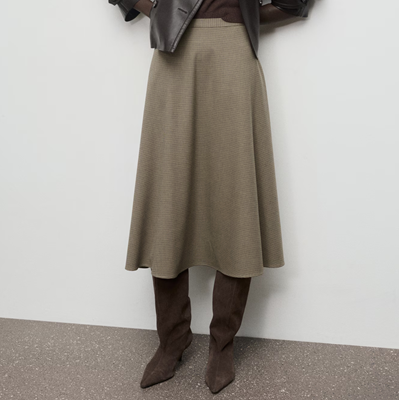
Our daily workwear reports suggest one piece of work-appropriate attire in a range of prices.
This wool-blend skirt from Mango is a great opportunity for layers this winter. I would add some fleece-lined tights, a sweater, and a blazer for those days when you just don’t know what temperature you’re going to be dealing with in the office.
(In my BigLaw days, the temperature would automatically go down at around 10 p.m., and I would be at my desk at midnight with giant cashmere scarves wrapped around my entire body.)
The skirt is $99.99 at Mango and comes in sizes 0-10, but today it’s marked down to $59.99. This one doesn’t come in plus sizes, but they have a similar option with sizes XXS-4X.
Sales of note for 10/23 (ALSO, friendly PSA – check any NAS or Amazon Prime Day purchases for the return policies…)
- Ann Taylor – 30% off your purchase + $50 off your $200+ purchase
- Brooklinen – Friends & Family – 20% off sitewide and 50% off select bundles
- J.Crew – Up to 40% off select fall styles. Also, donate any gently worn coat in one of their stores and get $25 off your next purchase of $125+.
- J.Crew Factory – 40% off new arrivals + extra 15% off orders of $100+
- M.M.LaFleur – 72 hours only, save 20% on jardigans (Try code CORPORETTE15 for 15% off on other items)
- Nordstrom – 5840+ new markdowns for women, up to 40% off
- Talbots – 50% off one regularly-priced item, 40% off everything else
- Theory – End of season sale is on with extra savings (new prices are marked)


the link for the skirt takes me to Target
whoops, fixed it, thank you for reading!
I am too preoccupied with money, and I would like any suggestions on how to make it less of a focus for me. I don’t want this to turn into a wallet-measuring exercise (and please just skip if this is anxiety-inducing for you as well!). I work at a nonprofit and I really value the work that I do. My husband has what I consider a unicorn job for him. We both make just over 100K, but we live in a VHCOL city and have two children. We’ve made it work because we have a rent stabilized apartment. I do manage to max my 401K retirement, but my husband saves only 3K per year. I vacillate between thinking – ok, we’ll manage to save enough to be able to retire one day, that’s enough, you can chill, and then internally freaking out and trying to maximize savings through coupons/deals/etc.
Our budget is very tight on a month to month basis. My husband doesn’t really get worried about this – I think maybe it’s just fatalism/checking out? But sometimes I see myself in the post descriptions of people complaining about their overly-frugal husband who doesn’t let them have new furniture, etc. I would like for this to take up less mental space for me, but worry that if I “loosen up” then our budget will be completely blow. Any strategies on how I can ease up mentally? This isn’t really about finding a higher paid job or moving somewhere LCOL – I want to be able to appreciate what we have (though maybe I’m just naive?).
My first question is, do you have a literal budget — which is actually a spending / savings / donation plan? If not, then you need to do one, because for you that budget will be a benchmark to know if you’re doing what’s needed with your money.” Right now, your emotions and fear are your benchmark, and that’s not a good strategy.
Also, have you done any retirement planning or used any solid financial calculations there — again, as opposed to whether it feels like you have enough/don’t have enough.
If you have a budget, and you’re meeting it each month, and retirement calculators tell you that you’re generally on track . . . and you’re still freaking out / panicking / being super-frugal when it’s not needed, then I’d suggest you start looking at your money story. Consider what meaning money has for you, any money fears in your family, and whether other anxieties/stresses are landing in the money question for you — that’s where they manifest.
Thanks, this is helpful. We do have a rough budget. Part of the disjunction is that it appears we would be fine by my standards using retirement calculators, but then I (a) worry that I’m wrong because everyone else seems to have much higher final numbers? (b) the calculator is based on us continuing to save at this rate for another 21 years, and I know that so much can happen in this timeframe. But ultimately – I think it comes down to increasing my confidence in my own ability to figure it out if something unexpected happens. My mom was very frugal growing up (no father) so that impacted my view. And it’s partly a relationship issue – I feel like I’m the mean no fun one, when we both could probably just compromise a bit more with each other’s positions.
I would move from a rough budget to a specific one. I’m frugal, and a specific budget gave me permission to spend the amounts of money I’d allocated in different areas, because I knew I was doing what I needed to do with my money. For you, specifically address your “mean, no fun” areas where you tend to clamp down in fear, put actual budget numbers to those categories that allows for some enjoyment and fun, and then COMMIT TO SPENDING WHAT YOU’VE PLANNED TO SPEND. I’d give different advice if your husband was here asking for input. I’d be telling him he had to deny himself, curb his spending and not go over the budget category. But you don’t need that advice. You need to work on having fun and getting enjoyment out of your money when it’s actually there to enjoy.
This has never really worked for me because I don’t have any confidence in the allocations insofar as I essentially just made them up, and because healthcare costs have been so unpredictable.
If you track spending for a few months you will be able to make very accurate allocations. Health care is a wild card that we deal with by maxing our HSA and not considering it in the budget. I also have a line item in the monthly budget for big one-time expenses. We tend to get hit by around of these per month and they are usually within a certain range. If we don’t spend it, it rolls over to the next month.
It’s easier to figure out all the things you must spend money on and then see how much you have left over for nonessentials. That can be one bucket you allocate as things come up. But you need to budget the majors, housing costs, insurance, cars, etc.
It sounds like you are operating your budget on hopes and ideas (albeit frugal ones) rather than on facts, and therefore the uncertainty is feeding feelings of anxiety.
Have you actually sat down and developed a forward looking budget? And spent some time with a few retirement planning calculators? I like the nerdwallet ones since they are free and not salesy-pushy.
Having actual data about your financial status is a good starting point to help yourself determine whether you need to make changes to reach your goals.
I will be completely honest about what stopped this for me – more money, specifically when we crossed the line to over $200k annually. Less flippantly, 100k in a VHCOL city does not give you much wiggle room to not think about money. It’s a tight balancing act when you think about how what percentage of your annual take home a $1,000 unexpected expense is. So, this internet stranger is telling you that you are doing a great job if you are making it work and still maxing out your 401k.
I agree. Your HHI isn’t high enough that you can spend freely without a worry. I understand that as you get older it feels like you should be able to loosen the reigns (and it seems like your husband has that mindset), but in a VHCOL you’ll have to continue strictly budgeting. Put pen to paper, figure out where the money is going, and agree on a cushion you’re both comfortable with. $3k for a family of four would make me nervous as well.
At 200K gross with kids in VHCOL, they are doing very well to max one 401K and put $3K/year in the other. They need to make more money or move to an area with a lower cost of living if they want to save more and/or improve their cash flow.
Depending on the kids’ ages, they may be banking on a “day care raise” when the kids start public school. This never materialized for us because aftercare, activities, and summer camps, then college, replaced and eventually exceeded day care in the budget.
She never said he spends freely, just that he doesn’t spend all his time worrying.
This is true! While he spends more than I would like, he is not a profligate spender!
+1
I read the OP as saying both she and spouse earn $100k, so HHI of $200k. There is a huge difference between those two number.
They are over $200k annually. She said they both make over $100k.
100% agree with this.
I’m in a VHCOL area. To feel comfortable I need a household income of $350-400k a year. I’m a single mom who is paying for everything for 3 children so my expenses align with yours.
Working for a non profit is great but they need to pay your properly. It’s not a unicorn job when you can only save $3k a year. You and your husband need to sit down and discuss how you are going to increase your income and better manage your expenses. I have two jobs and recommend this approach over going for one job that pays more.
Two possible thoughts:
1 – Given that you have kids, I’m guessing you’re somewhere in your 30s/40s – so maybe not yet at peak earnings in your careers, and also high expense years (especially if childcare is in the picture!). Saving for retirement early is good for benefitting from interest; but also there’s a reason a lot of people bulk up their retirement accounts later in life, and maybe you all can do this too
2 – One of the best things about having a solid budget is that it makes it really easy for me to see that the big things in my expenses well outweigh the small stuff: rent, car, healthcare, etc. Like if you keep your food budget to the bone vs. spend moderately but freely, the difference between those two numbers at the end of the year is not that big.
3 – Skip this part if comparisons stress you out; but for me, it’s genuinely helpful to keep a big picture sense of where I am economically compared to the rest of the world, and prevents me from spiraling. About half of US households have no retirement savings at all – that’s obviously a vulnerable position to be in, but people keep living their lives. On a global scale, I am wildly wealthy. When my brain says “be scared, you don’t have enough wealth to use money to solve *every* possible problem life might throw at me” (eg. paying for healthcare in an out-of-network system, indefinite 24 hr home assistance in case of disability, buying citizenship abroad in some Caribbean investment scheme); I have to remind myself I do actually have enough wealth to be a safety net for the kinds of things a lot of the world doesn’t (I’ll never worry about dying because I can’t afford $10 antibiotics or antimalarials; I can pay my insurance premiums; if I needed to, I could pay for a lawyer at least a little while; if my car was totalled and I needed another one to get to work before I lost my job, I have the credit to make that happen, etc).
This is so helpful (and validating!). The food point is very well taken. Through my work, I am constantly exposed to individuals making it work with much less than I have. I think my problem is a disjunction with my “cohort” of friends whose careers – because they have not pursued nonprofit work – have pretty vastly outstripped our earnings and lifestyle. It’s really just me needing to be firmer about pushing back on my brain when it goes into spirals.
I also have peers, and people much younger than me, making much more money than I do — with the beautiful houses and expensive vacations that go along with it. One of my rules for myself is “compare down, not up.” Meaning, compare my lifestyle with those who would be amazed and stunned at it, not compare my lifestyle and money to people earning more than me. When I get dissatisfied with my small, worn, 1-bedroom apartment with 30-year-old finishes, I think of the many people around the world who would be agog at the soft carpets, comfortable furniture, spacious bedroom, beautiful art on the walls, well-stocked fridge and pantry, totally reliable heat and air conditioning and water and electricity, and utter safety of my neighborhood. There are women in refugee camps right now who would weep in stunned gratitude to have my living conditions.
Love this.
Real talk. Lots of problems are solved by actually making more money and you will face retirement issues based on what you’re earning and saving. In a VHCOL area there are usually a lot more job opportunities. I would get a better job and donate to your nonprofit once you’ve got more money in the bank. Your peak earning years are short. Don’t waste them.
I agree with this. The path OP is on will result in extended working year and difficulty in reaching retirement. Relocation, or a higher paying job, or both, sound necessary. OP, I think you’re appropriately focused on this given your circumstances. I echo others in saying you need a stringent budget – it is the kind of situation where you really need to absolutely know where every dollar is going. I would encourage you to see if you husband will help you carry this mental load. It is his situation, too. He needs to pitch in, even if it is just mentally/emotionally.
He also needs a better job.
She says they are earning over $200K and saving $26,500 per year for retirement. She added that they are on track to meet their retirement savings goal and that they keep to a budget. Yes, things would be more comfortable if they earned and saved more, but she acknowledges that her emotions are more of a problem than the actual numbers are.
OP, I am your husband and you are mine. In my marriage each of us feels as though they are the rational one. I think I am the rational, reasonable one because I do the numbers and can show that even if we encounter some setbacks we should come out fine. My husband thinks he is the rational one because Saving Is Prudent and Spending Is Wasteful. His refusal to spend has actually ended up costing us in the long run. If we had stretched a little to buy a newer, more functional house back when they were affordable, we would not now be in a situation where we are facing $200K of deferred maintenance that will not increase our home’s value, at the same time as we are paying college tuition. We have wasted thousands of dollars repeatedly fixing old junk cars when it would have been a better deal to replace them with reliable new ones. If we hadn’t saved so much for retirement we would have saved more in cash to pay for unavoidable home repairs and would be in less of a cash flow crunch right now. Etc.
Well I think her actual numbers are a problem and just because you’re emotional doesn’t mean it’s not grounded in a factual reality. 200k in a VHCOL is poverty level today.
200K in VHCOL is not poverty, there are tons of people living below the poverty level in VHCOL cities! Good grief.
$200k is not poverty level. That is ridiculous.
Seriously – 200k is poverty? Not even in VHCOL. Get a grip folks.
If neither of you are going to get better jobs or perhaps work second jobs to earn more, what else is there to do? Make sure what money you do have is invested wisely. Become polyamorous so you have a third earner in your household. Get a roommate. Plan to move to a LCOL area in retirement — lay actual groundwork and understand that you may not have the option to live near your children in old age. And so on.
This is an absolutely wild take and I love the chaos of suggesting polyamory as a family financial strategy.
I take this as consistent with advice that she needs to get more money coming in. If she’s not going to get a better job and he’s not, you’re looking at extreme options.
To be fair , I thought she was saying 100k was the combined household income 😂
Yeah 100k HHI vs 200k HHI are not and day, especially in a VHCOL.
We have access to a financial planner via the company that has my 401K. If you do as well, be honest about your spending and have her run the numbers for you.
If your husband sticks to the budget but doesn’t constantly fret over it, he has the right approach. Worrying doesn’t do anyone any good and is not morally superior. Taking concrete action is what produces results.
How old are your kids, and are your childcare costs likely to drop soon? That could free up money for retirement savings and generally spending more, but I agree that more income is really the key to feeling less stretched.
I work at a nonprofit and my husband is a teacher; when our son was born 13 years ago, I think we were making around 150K total and living in a NYC rent-stabilized 1 bedroom apartment. For us, when our son started elementary school–even free PreK–we started to have more wiggle room, but that is partly because my husband is a teacher and is off in the summer and school holidays, so we don’t have to spend so much on camps. My husband also saved a lot when he was in his 20s. And we both got substantial raises around the same time as our son started preK, so memories are murky. It IS nice not to have to track every dollar.
Regarding nonprofit careers and making more money – in my personal experience, nonprofits can pay decently at higher levels, although if you are making over 100K you are probably already there. Take a hard look at what advancement potential is available to you, as there are also fewer jobs at higher levels. And the current job market is awful.
I don’t know if this will help but I am 60 now and had the same exact financial anxiety and frugality as a result, my whole adult life. It has gotten better as I have made more money, as others have said but never fully went away.
That said, in looking back at my live as one does at 60, my one big take away is I wish I worried about money less! It ALWAYS worked out and I did not need to worry as much as I did. I am not sure how I could have changed that but maybe hearing this will allow you to let go a bit.
Yes. I’m the same age. I often look back and wish that I’d spent a few hundred more here and there, to buy more experiences or enjoyment. That money wouldn’t make a substantive difference now, but the enjoyment I experienced would.
Different Anon here: absolutely, I feel bad i didn’t let my kids have their own laptops in high school (this was 15-20 years ago when it wasn’t absolutely a necessity, but I’m sure it was annoying for them). OTOH, they went to good state universities with no student loans. But I realize now that a few laptops wouldn’t have made a difference.
Yes, this is where I am – I do think this is a me issue (although point taken that more money is helpful – I am making a conscious choice to be in the field I’m in) and largely about emotions/childhood stuff. Glad to hear it worked out for you.
This is not a direct answer to your question but the very best thing I did for myself and my marriage and my stress level was to create a net worth spreadsheet and updated monthly or quarterly. It helped me see that even though my bank account wasn’t getting any bigger, my overall net worth was growing between paying down loans From School and the mortgage payment and the car payment, etc.
It was a habit I got into almost 15 years ago and now we do it and we can see the benefits really paying off as we get into our mid 40s
I definitely still struggle with this myself! But I will say, a strict budget actually made it worse for me – like telling someone with an ED to plan their meals with a focus on calories. It’s much healthier for me to have more flexibility – income is $X, required bills are $Y, $Z goes to savings and the rest goes into a “whatever you want” bucket. This is also better because my husband has an inconsistent hourly job and some months he makes $1500 others he makes $3000. We live well below our means, but I still get panicky when we start spending money on things that aren’t strictly necessary. But when I have the actual numbers in front of me showing me that we’re on track with our savings goals, I can talk myself down or say “no, doesn’t line up with our goals.”
Reflecting on it more, I actually think one of the biggest issues is that I want all my spending to be values-based and my husband sometimes values different things than me or prioritizes differently. I do not want tech toys or nice cars, I want to be able to have a garden and space for a big family and it bothers me to spend on anything unnecessary until I get that. My husband (quite rationally) thinks that buying a couple video games right now isn’t going to meaningfully affect the timeline of those goals. I share this to suggest that maybe you have similar hang ups – it’s never just about the money, it’s about what the money represents to you.
The only thing that has made headway with my overly frugal husband is framing spending and saving in terms of values. Money does not have intrinsic value; it’s what it buys you that has value. There are some shared values, such as experiencing live arts performances, eating delicious healthy food, and our daughter’s education, that we already spend to support. We have agreed that there are other values we want to spend on in the near future, most importantly being able to open our home as hosts.
The value of saving is security, or at least perceived security. I feel that cash savings provide a measure of short-term security that can be eroded by inflation, and that investments are a necessary evil that will probably evaporate by the time we are planning to use them. I am willing to throw money into retirement investments because there is no viable alternative, but I’d feel more secure if we prioritized up-front spending on having a paid-off, well-maintained home. My husband feels that the path to security is to have all the money we will need for retirement in hand decades before retirement, and that this value supersedes all others. The correct view is probably somewhere in the middle.
I personally felt a lot better financially when I sat down with a financial planner to forecast what I wanted to have in retirement yearly and where I stood against those goals. It also helped me align where my money was going and how it aligned to my values. Getting those spending categories aligned made me feel less stress to spend money. For instance, if you value trying new restaurants, then yes, you want to dedicate a certain amount of money for eating out. Same if you value going to a gym. You probably also need a certain amount of money that is just ok to spend individually with no questions asked.
Anyone care to share how much they spent on clothing this year?
I got a few responses over the weekend, and the answers were quite variable!
I’m somewhere between 1-2k. Hem lengths have gotten longer so I’ve replaced some skirts and dresses. Maybe I’ll stay under 1k next year.
Ugh, too much probably.
Almost nothing. Waiting for that mythical day when I lose the weight I gained postpartum 😂😂😂
Hey internet stranger, if you can afford it, treat yourself to some new clothes that fit new – life’s too short! I am dealing with perimenopausal weight gain and keep buying new sizes of used clothes at ThredUp. You can get a lot for under $20.
I know, I know, but my local Old Navy closed and I just haven’t got it together to go to the next closest one. I hate shopping so it’s not really a priority.
If I had to guess, $6-$7K, but that is for 5 people.
I was actually looking back at my year-to-date spending yesterday, and between clothing, shoes, and accessories, about I spent about $7K which was truly shocking to me. $2K of that was on a few luxury goods, so that makes sense, but the rest of it was on a lot of random things that I guess just added up over time. I have lost a lot of weight this year so I did buy a bunch of new clothes in the past month or two as my old clothes are hanging off me. But still. I *REALLY* need to focus on getting that number down next year.
About $1,500 (not including shoes), which is more than my normal spend on clothing. I finally admitted to myself that the size I am today deserves to wear clothes that fit properly. There is no reason my body should be punished for being the size it is by being forced to wear ill-fitting and unflattering garments.
Most years my clothing budget is about $500, also not including shoes. Shoes are another ~$300 per year.
$10,000+ on clothes and shoes, another $5,000 for a new purse. I tend buy quarterly, around $1,500 to $3,000 depending on what I like, mostly higher end so the overall volume of clothes added are a few outfits per quarter. 40s, DINKs, have a big job.
The environmental impact of this is wild to consider. I did not realize there were people shopping like this.
uncalled for. I’m at this price point, too. This is not ordering crateloads of fast fashion. This is a couple of pieces a quarter.
It is the pieces you are replacing/throwing away that have an impact, too. It is a misconception that only “fast fashion” has severe environmental consequences. And, many high-end designs are made in China by slave labor. There are compelling congressional reports on this available online.
who says I’m throwing anything away?
Surely spending much, much less on fast fashion is environmentally worse?
Just because one is worse doesn’t make the negative environmental impact of these choices “good.” Moderation is the key.
Moderation is a meaningless concept that means something different to everyone.
If someone is choosing to support the absolute most sustainable production choices that exist, their clothes are going to cost a fortune. And if no one supports sustainable clothes production, those skills could be lost while everyone else wears plastic.
I mean, sure you did. There’s obviously a market for expensive clothes and purses.
People with five figure clothing spend are likely buying just a few luxury items.
Fwiw I think I spent around $200 on clothing last year, so I’m very very far away from this. But the environment doesn’t strike me as an issue here unless she’s spending $10k at Old Navy, which I highly doubt.
Bugger off. $10k+ isn’t buying lots necessarily if it’s high end purchases.
You aren’t dumping on anyone else, just the successful woman you are clearly threatened by.
I wish I still had my career where I could spend $10k+ a year on clothes. Alas, I made my gap credit card work for me and my children. My spend was the grand total of about $5. I’m thrilled BR has some nice sneakers online. I can spend my points. They will cost me $1-2.
Currently in peri weight flux and shape shifting. Ugh. Spending it all because I can’t wear clothes a size too small. Also, my feet spread a bit. Always shopping.
Solidarity! I posted above; ThredUp is my friend.
My feet spread too!!! Argh I didn’t realize this was a thing. They didn’t change at all during pregnancy so I thought I was safe.
3 K. Have hard to fit body and need to spend on alterations to make things work.
More than I’d like. Probably around $1,500.
I should add, that is for me. If you add my husband and growing teens/tweens, it’s a whole lot more! We had to replace nearly an entire wardrobe for our 15-year-old this year, and the sticker shock was so real.
$839.70 plus some riding togs that got lumped into the Horse budget section, so probably around $1-1.1k once that’s accounted for.
Probably upwards of 30K. Big job. DINKS. big city. Clothes are important to me.
Approximately $550.00.
I just tallied it up and it came out to a little over $800, which is more than I was expecting. I’m a clearance/sales shopper and clothes bring me joy, but I’m going to work on being more mindful in the coming year about what I purchase.
I’d guess $3-5k, including shoes, workout gear, accessories, etc. This is average or low annual spend for me, but I do aim to roll way back as I am able to fit into some different clothes now, have better curated my closet and invested in some things I will be happy to wear for years, and have somewhat stabilized as to my work and home life needs.
Assuming my credit card summary is categorizing things correctly, around $7,000. I finally accepted I wasn’t losing weight and just needed to buy new clothes, so I basically redid a large chunk of my wardrobe (including work shoes, which were just old).
Ugh so much this year. Probably $7k..? More? I lost a lot of weight (bra poster from down below) and started a Big New Job basically at the end of the weight loss. So, it was much, much needed. But so much that I’m apparently a top spender at JCrew and got a holiday present from them (haaaa – their stuff just fits me well and I like the aesthetic?!).
Checking my budget/spending app, and I can say that in 2025 I spent $225 on clothes for the whole family this year. Family is myself, husband, toddler. This year was lean because I had a baby 2024 and spent a lot on clothes then with size fluctuations, so I was focused on reducing my wardrobe this year. I primarily buy used/thrifted, and if I buy new it’s costco basics or on clearance. I also make/repair/alter a lot of clothes as well. My in laws love to gift clothes. I think during a typical year I’ll spend twice as much on clothes as I did this year.
Does this include the cost of materials for clothes you make? It’s hard for me to imagine that you spent so little on clothes for three people, even if they were mostly thrifted.
Less than $800, but $400 of that was on bras because I finally found some that fit and decided I couldn’t bear to keep wearing the old ones so I got 5-6 new ones all at once.
Probably around $6-7,000. Slightly above what would be about 5% of my take home pay.
This is because I replaced many things this year — all new bras, replaced some shoes I bought before the pandemic — and also upgraded some items to a higher quality. I also bought a new work bag to replace a bag that was 7 years old, bought a new purse, a new suit, etc. These won’t be annual purchases.
I haven’t looked yet but I’m guessing in the $3-5k range. I was doing pretty well on not buying unneeded stuff this year until I stopped in at Manolo and dropped $1k on a new pair of flats. Whoops.
I group clothes, makeup, and hair and skin care together in my budget. My total for 2025 was $1225. I’ve lost some weight recently, so my “old” clothes are fitting like new again.
For those of you who are back in the office with prohibitions on working from home, what are the expectations when calls are scheduled outside of your working hours because people were across time zones, or when a call is scheduled during a commute? I don’t think I can be expected to get to the office at 6 am, meaning I have to leave home at 4:50. So far, staying home to take the first call has been grudgingly tolerated but I’m hearing rumors that it won’t be anymore and I am obviously dusting off my résumé but wondering what others are doing.
WFH is begrudgingly tolerated for calls outside of work hours. Semi frequently I need to take calls at 4 am, my badge doesn’t let me into the building before 6, so *shrugs*. I’m also unionized though so management knows they’re playing with fire.
We have a concept called credit hours where if you have to work outside your official duty period, you can do it from home (otherwise, no telework is permitted). You log it on your timecard and then get credited back those hours to use for leave. It has be approved by your manager ahead of time though.
This sounds very junior.
This sounds like government to me. My GS15 boss does this, it’s not junior.
But also, while we’re salary we also can’t just take an “it all comes out in the wash” approach to time. We need to record 40 hours each week on our time card (and it has to align with our badge swipes).
Per the anti deficiency act, we also cannot work without compensation (it’s literally illegal) hence credit hours
those kind of calls it is 100% expected that you’re at home, and possibly commute in later / out earlier to accommodate.
We are every day in the office but it’s absolutely fine to commute after morning calls or leave early to take afternoon calls at home.
Rhetorical question: why on earth would there be any value in requiring you to be butt-in-office-chair for a freaking 6am phone call with people who are in a different time zone?
To soothe the ego of control freaks and nothing more?
Nailed it!
I don’t think that is true. I don’t have a home office. Mornings are a hustle with getting kids out the door and the dog walked. If I want to appear professional or even concentrate, I can’t do it at home then.
If I had to leave my house at 4:50 to get to the office at 6, I wouldn’t get to see my kid at all.
but do you think someone who does have a quiet space should be forced to come in at that hour? I don’t!
I didn’t get the feeling that this was an everyday thing. If it is, it’s shift work and I’d get to see my kid later in the day (and probably have a much more functional kid and husband, since they only seem to master tasks when I’m not around). I used to pick a night to work late each week so that they would learn to function a little without me and I could just work and get stuff done with no interruptions. AT WORK. If I didn’t have work, I’d go to the gym or meet friends but I kept my away time constantly on the calendar and we were all better for it, I swear.
But surely you can see it’s nice for you to have the option to go in if it works better for you, while others would do better with having the option to stay home.
That’s a benefit *to you*. You’re free to choose that, but there’s no need to require someone to come into the office when that person is perfectly able to appear professional or concentrate at home.
My kids aren’t even awake at 6 am! This would be about the easiest time of day for me to take a quiet call from home.
yeah as someone in a hybrid work environment this sounds ridiculous.
Someone blew it and took the call from bed, their bathroom, or while cooking eggs and wrecked it for everyone. If people could just be professional, it would be easier to relax. But there is always someone who just does not get it and ruins it. Each year I hear an audible toilet flushing on a call.
Still a double standard. There’s always that person who picked their nose or was watching YouTube videos in the office.
+1.
I’ve had flex or full remote in a field with constant meetings for more than 20 years. I have yet to hear a toilet flush.
What is the reason for prohibition from working from home – is it “we work better in the office/collaboration/etc” or is it “confidential information”?
I worked in a *very* anti WFH company (like, they got themselves declared “essential” so they could require staff to come in in person even in peak 2020, for roles that it really wasn’t necessary); and even there it was perfectly acceptable to take your weird-time-zones calls from home. They were very big on “arriving on time” (the tracking system emailed your boss, your boss’s boss; and at least one VP if you were a minute late), and even there “I have back-to-back calls from 6am-9am, so I’m going to do them from home and then drive in afterwards” was an acceptable reason to request an exemption from being dinged for badging in late, as long as you cleared it with leadership ahead of time.
So all that to say, I’m amazed anywhere out there is even more anti-work-from-home and wouldn’t allow this! Although, obviously different if they are anti-WFH for security reasons.
“Work is best done in the office where we can see each other and ping ideas off each other.” Unclear who I’m seeing and pinging ideas off at 5:47 am in an empty building.
Yeah, in that case, I think requiring ppl to come in for off-hours calls is out-of-norm even for VERY “work is best done in the office” cultures. Is it possible the rumors are just coming from people who oppose RTO more broadly and are catastrophizing?
If the rumors are reliable, this is weird enough that I’d probably say to my boss “Hey, I’ve been hearing that there might be a policy change to require people to come in even for a 6am call/8pm call/whatever. You know me, you know I am working regularly from the office, you know that I’m happy to do these calls because it’s what the team needs even though I would *much* rather still be asleep then (or whatever is true); and I’d find it pretty demoralizing to have to commute in at 5am; when right now I can come in afterwards at 8am and still be in person for all of my meetings with the local team. If there’s any way for you to advocate for an exception for our team, I’d definitely appreciate that”.
Key point in the above script is that you’re presenting yourself as totally on board with RTO in general, just not the insane 6am calls.
OP here and I’m job searching instead. History suggests they won’t be open to reasonable/ordinary compromise.
I have found that a lot of times it’s better not to address these potential issues directly and just to wait and see what happens. So many times I worry about something that could happen, and then the issue disappears because someone else has realized that the situation is unreasonable or inconvenient for themself and makes a change.
I would not initiate the conversation proposed above unless I had solid information that a change in expectations had actually occurred. Until then I would continue to act as if it were perfectly natural to take early calls from home because office hours start at 8:00 and of course no one is in the office at 6:00.
We have a 3-day in office requirement, but arrivals and departures aren’t monitored. We’re allowed to come in “late” and leave “early” to accommodate making calls where it’s most comfortable for us. My team find would find it odd if I came in at 5:30 am to dial into a 6:00 am call (but would accept my explanation that the office is a better environment *for me* to focus).
This sounds ridiculous. I would take the call at home and go in after. Screw the idiot who thinks you should be in the office for that very early morning call. Even in the days prior to WFH you shouldn’t have been expected to be there at that time.
Are you also a fed? I’m just taking them from home and telling them IDGAF
My team is 100% in-office (with good reason, our work involves tangible assets we need to have access to) and we definitely wouldn’t require anyone to be in-person for this!
Need some bra help. I have been measured at Soma and Nordstrom. They had the same exact measure – 38C or, shockingly to me, 36D.
I’m 41. I’ve had two kids, br ea st fed for 6 months each, I recently lost almost 100 lbs. Despite all of the above, they’re not crazy saggy. In fact, I have a br eas t oncology/surgeon PA I see 2x year because I’m high risk and even she was like they really don’t look deflated like you typically see from all the above events (she also does plastics so has some perspective!). So, the girls have been through it but they’re doing ok!
THAT SAID, I cannot for the life of me find a bra that fits well. I feel like the top of my b oob is missing “meat” and doesn’t fill out the cup. Said differently, the rough triangle shape of the cup that tapers up to the strap seems like it needs to almost be cinched/tapered in or have material removed so it fits better against my upper br east.
Help? Does this make any sense? Where can I go to get a proper fitting… I’m so frustrated! I thought Nordstrom and Soma would be it…. I’m tired of going to stores and still being left with the issue. Is there an online service that somehow could help??
Look through redd*t r/abrathatfits
+1
This is what worked for me.
Yes, and specifically use their calculator. What you’re describing sounds like you’re in the wrong band/cup to me.
This – use their calculator, and move away from one piece molded cup bras. You likely have a size and shape mismatch going on right now.
I don’t understand how you prevent show-through without a molded cup.
You need a bra store where a lady comes in with you and does measuring. And has a lot of inventory from a lot of brands. Soma doesn’t run small enough for my band size. And I’m very sideways oriented. Expect to drop some $.
You need to go to an old school store. I’ve always maintained that the best ones are the ones that stock the $300 grandma nighties from Europe. Post your city and people may have suggestions.
Boston! North Shore but I’ll go anywhere in the city or along 128!
Oh wait – there is/was exactly what you are looking for in Boston – I actually made a trip there (my sister lives there) to visit that exact shop! Let me text her and get the name of the shop!
Ok update- the owner of the shop I went to died and the shop closed, but the woman who did my fitting opened her own shop, called Tutti Bellissima in Norwood. Good luck!
I agree that you need a non-chain bra specialty store ideally, but if you must try online, try Herroom.com and read the fitter’s comments. There is also a good chance you need a smaller band size and larger cup size. I think my breasts are similar (albeit larger cup and smaller band and probably more pendulous), and I have had good luck with Prima Donna Satin Seamless Underwire (016-1330), Chantelle 3281, and Fantasie 4510.
I think what you want to search for is bras for a shallow top.
But how do you find them? I am convinced they do not exist.
Balconette bras
some brands will tell you which ones they think are good, like wacoal – https://www.wacoal-america.com/bras/shallow-top-full-bottom?srsltid=AfmBOooPUd9lwls0PkS5Aotzj66vquwfATURvNq2Fkll_Vqg4P8qLcQU
this might also be helpful:
https://www.barenecessities.com/blogs/learn/what-is-the-best-bra-for-my-breast-shape
but – my girls are like this (but bigger than yours I gather) and i dislike wacoal generally. my last few favorite bras have been from chantelle, bravado (they make a non-nursing one that nordstrom had), and evelyn & bobbie. for wired bras i like the ones like this with the high string details even though they feel a little BDSM which, sexy when i want but a PITA when i realize i’ve put on a shirt with too low of a neckline and i’m going somewhere like a parent-teacher conference.
https://www.elomilingerie.com/us/en/us-outlet/lingerie/bras/plunge-bras/brianna-rainforest-plunge-bra/p/el8080rat/
https://www.herroom.com/upper-breast-fullness
The abrathatfits subreddit will have recommendations for specific bras, and possibly stores depending on your city.
Look for bras made for “teardrop”-shaped girls.
+1 – I’m a 32 or 34 D and the Natori bras (NOT feathers, the t-shirt bra) fit my ‘teardrop’ shape best.
Find a small, local shop. The women who run them are the best in the business.
It’s more about shape, so try on different styles. Natori used to have a style called Zone Perfect, but they may have renamed it because it seems discontinued. Chantelle also tends to fit me better, but never the full cup styles. You can also try something like this: https://www.wacoal-america.com/bras/shape-revelation-collection/shape-revelation-shallow-top-underwire-t-shirt-bra-853387
It looks like Wacoal even has a page dedicated to different breast shapes with a shopping guide. https://www.wacoal-america.com/breast-shape-guide
Your situation sounds a lot like mine! I have dense tissue (so the tissue does not fill the top of the cup due to weight) and flared ribs (which makes it hard to get a band size that fits comfortably.). I tried a few professional fitters who were not helpful due to not taking these issues into consideration.— you may have better luck with that. Solution for me was trial and error, resulting in an underwire bra in a band size that’s comfortable for me (to support the dense weight) combined with a full coverage cup in a stretchy fabric (which handle the top of cup issue). Non underwire models are actually not comfortable at all. Good luck, it’s a journey!
I’m the same and will have a helpful reply this evening. Check back later.
I went with underwire push up bras because they gently shove everything into place.
Anyone else see the article on childhood independence circulating (author Kelsey piper, “how getting richer made teenagers less free”) saying many important things and referencing a poll wherein 36% of parents thought it was not appropriate for their kids to be home alone for an hour or two until ages 14-17?
It’s overall a good read and of course taps into a lot of what is discussed here: modern parenting is not really serving anyone, kids and moms alike. Curious how folks react to it.
Thank you for posting, I think this is really interesting. I have a 7 and 9 year old, and recently had them come home from school by themselves for a few hours because my husband and I both had work obligations. They were fine. We just moved out of the city into a suburb and the amount of freedom they have here is really great. BUT- I honestly think they would have been equally as safe in the city, but the judgement we faced there about two children being even 20 ft away from us on the sidewalk was truly astonishing. That stat about people willing to call CPS does not surprise me. Here in the suburbs, all the adults are more relaxed about seeing children walking by themselves (even though the safety stats are probably about the same) so as parents we can feel comfortable giving them more freedom. It’s hard because I think it really comes down a lot to what a community agrees is comfortable, and as an individual parent it’s hard to swim against the tide.
We moved away from NJ because of this. It was not how we wanted our children to grow up. We took big (BIG) hits to our careers, but we now live outside of a semi-rural town and our 11- and 15-year-old kids bike everywhere. We didn’t need day camp last summer because the 11 year old was biking all over the place with his friends, and the 15 year old biked to his summer job. We truly turn them out and tell them to come home for dinner.
The town we live near is a summer resort, and the (barely) three-month season is all hands on deck, so all kids old enough to have a job work, regardless of their socio-economic bracket. I think this is actually one of the best things about the town – the kids in aggregate don’t seem to have as many mental health issues as they did in NJ, and I think in part it is because they are fully integrated into the community. They are needed and the town wouldn’t be as prosperous without them. There are downsides – the middle and high schools start crazy early so that the kids can get to after school jobs for one, but I think the upsides outweigh them.
As someone in NJ, this is strange to hear. Our town is very cool about kids gaining independence. Partly, probably, because lots of kids walk to school (my 8yo and 11yo walk home alone, for example), and because we have a bustling downtown area where kids congregate. There are always kids biking and hanging around in the parks unsupervised. You must’ve lived in a very different part of the state!
+1!
Oh that’s so interesting. We moved to the suburbs and are moving to the city and I imagine my kid having more independence. The burbs are so car centric. My son meets me at the library after school and he’ll regularly have a mum trailing him because “he was all by himself…”.
Not the OP from NJ, but also a NJ person. I grew up in a pre-car industrial village, so I could walk everywhere. My younger sibling was in a car-dependent “township” area in high school and IMO was worse off for it. The walk to the bus stop was almost a mile, no sidewalks and the high school was out several miles from the small walkable village core. YMCA was 15 miles away. NJ didn’t let you drive until you were 17; both parents worked. No bueno.
In what publication?
Aren’t there restrictive laws about kids staying home alone now? I always thought that was more the issue.
Even where there aren’t laws you have to worry about norms. Where we live the general understanding is that if an unattended kid looks to be under 12 someone will call CPS.
My experience of modern parenting is that there is always someone telling me I am doing it wrong, and usually two people saying I am doing it wrong in the opposite way.
I feel this too.
Isn’t that the truth!
Kids are never alone because they are in year round swimming or travel soccer. They are never unsupervised until college, I’m convinced.
this is not true. where i live i do see kids biking around the neighborhood themselves. perhaps this is my anxiety talking, but even though we live in a somewhat expensive fairly safe neighborhood, we have had a decent number of armed robberies and so when you hear about something like that happening a block away, it doesn’t feel great to let my kids wander about.
I only see in my suburban neighborhood with families who have a nanny or where the mom doesn’t work, so some adult is home. My kids had to do aftercare at school, which they loathed, since we could not find PT on-the-books childcare. In middle school, they could take the bus home and just hang out, but there were no same-aged kids for them to hang out with, so maybe they’d walk to the park, but it was never the bliss I’d imagined due to many kids going into high-intensity sports or dance around that age. I hate that they missed out on a Tom Sawyer sort of youth, but it was the downside of 2 working parents and no local grandparents.
See, I think concern about armed robbery really doesn’t apply to a kid on a bike. The risk/reward ratio is too high so I can’t imagine them ever being targeted.
I can’t think of a single example of a kid on a bike being targeted anywhere I’ve ever lived, but I can think of examples of kids being accidentally shot while other stuff was going down.
This is absolutely not true, at least in my circle of parents.
In my neighborhood, they’re alone on motorbikes masquerading as e-bikes, which is even more disturbing.
Please post a link. I’ve seen other articles commenting on how kids are over-supervised in person and under-supervised online, which tracks with my own observations.
I kind of wonder about that poll and how it was phrased. Where I live school aftercare stops around age 11. I think that of the case for most districts in the US? It seems widely accepted that they can be home alone by then. Though I do see occasional social media posts from some parents concerned about that situation.
Our city has afterschool care in K-5 schools. I think it’s on offer at some middle schools, but IDK who uses it. Maybe some magnet schools where there can be a 1+ hour bus ride but probably not neighborhood schools with much shorter bus rimes. Many kids wouldn’t mind a quiet place for homework and a private car ride vs this is the age where bus rides can be very long and/or rowdy and that mix often doesn’t work well for some kids.
I was babysitting at 12, which in retrospect was a bit too young, but wild to think that 14 years old is too young to stay home.
My son is 8, and I could imagine letting him stay home now (good neighbours, generally risk-averse kid) but he HATES being left behind. He can walk to the library from school by himself, would happily go into a shop with a debit card and get a snack, but gets freaked out by being left in the waiting room at the dentist. Residual trauma from the time he lost sight of us in an hours long queue at border control, and didn’t realise it until they made an announcement about a “lost Scottish child!”. So I think we’re a few years out from leaving him home.
I babysat at that age too, but it was for people in my immediate neighborhood and my mom was home 98% of the time.
I started babysitting at 10, and honestly, seeing my nieces and nephews with my young children, it doesn’t seem so insane to me. This is very, very kid dependent but I’d leave my rule following 4 year old with 3/5 of the 10-12 year old cousins. Of the 2 tweens I’d say no to- one has ADHD and one has zero interest in younger kids.
my kids were allowed to stay home starting around age 8 for a couple minutes while I zipped another kid to school and back. My 12-year-old stays home freely and babysits others in the neighborhood for an hour or two. Some parents have trouble letting their middle school or stay home for even an hour, so there’s definitely a lot of of anxiety, but not in our house.
I don’t worry much about getting CPS called on my unsupervised teens since both are fairly tall and adult-looking. (I do worry about my white son’s friend group being hassled or worse by the police because most of his friends aren’t white or Asian.) Luckily we live in a pocket of LA where it’s actually pretty common for kids to walk or bike to school without their parents starting in middle school.
When my kids were younger, I did worry more about CPS involvement because I’d let them do things like play unsupervised in our front yard (I could see them the whole time) or walk to a friend’s house that was a block or two away. That said, CPS in my big city doesn’t have a reputation for going after unsupervised kids who aren’t super small (e.g., toddlers who walk themselves to a local liquor store).
I had a woman threaten to call CPS in a parking lot once but she backed down. My kids were in late elementary and I’d left them in the unlocked car for a few minutes. It was ridiculous enough that I offered to give her my full name, phone number, and address so she could make a complete report. She backed down because I think she realized it was a waste of her time.
I had onlookers discuss calling the police when I sent my 10-year-old back to the car to get her coat because she was cold, while I watched from the door of the store. When I called them out they hemmed and hawed that they had thought she was younger.
Good for you! The older I get, the more I am comfortable confronting busybodies and people acting badly.
Next time don’t give a crazy person your contact information.
Looking for ideas on wrapping an intangible gift. I buy tickets to an annual, recurring, event for my mother every year, but the only documentation I get is a receipt (not even the actual tickets) so I try to come up with fun ways to “wrap” it every year. I’ve done a box of confetti with the name printed on the little pieces, I’ve wrapped a calendar page with the date highlighted on it, but I’m coming up blank this year. She knows she’s getting this, and yes I could just print out the receipt and give it to her but I like to make it fun.
framed pic of you guys (or from the event) from a prior year?
This a very cute idea!
Nano banana to make a picture of “custom tickets” (like, that look like Willy Wonka golden tickets or any other thing your mom might get a kick out of), print out on thick paper and put in a card?
Is there a theme to the event that you could riff on? If a home and garden convention, perhaps a garden trowel?
Is there online promotion of the event that you could print out?
Is there an ornament associated with the event?
OOTD: vintage Harris tweed blazer (part of skirt suit), jeans that pick up the blue in the tweed. Casual law office. Dressed for my day. Is this what professors wear?
It sounds lovely and comfortable. I’m in a STEM field where most male faculty receive, purchased at Costco, 2 polo shirts, 2 pairs of pants and a pair of sneakers once per year from their spouse and call it good. Not my sartorial jam, but it works for them.
Yeah, also in STEM and I have never in my life seen anyone wear tweed! Hawaiian shirts are actually quite common in my field, and of course the polos too.
Also STEM and the only tweed-clad prof I encountered was my ancient Calc 1 teacher who was probably born wearing tweed.
But OP’s outfit does sound like it fits a professorial or academia vibe, regardless of whether profs dress that way IRL.
That sounds really cute!
I’m a professor and I’d definitely wear this!
Thoughts on the president’s address last night?
1600 Pennsylvania. Have known the address since grade school.
Seriously not spending a moment on keeping up on anything more than that. Why give it time or attention?
i kind of agree, but then i can’t stand the sound of his f’ing voice. i find a lot of peace in the meme that says something like, “one day we will wake up to his obituary.”
Yeah, no point in watching. Nothing is coherent or honest.
As someone who is deeply concerned for our democracy, I just can’t get on board with willful blindness at this point.
I certainly agree, but I can be well-informed without letting a seemingly coked-up old man yell at me for 20 minutes. Nothing will change if I just read later about whether he said anything important or just bloviated.
This
Yes, this. I think it’s crucial to be well-informed, but being informed does not require reading every take on a topic, or listening to each and every horrific thing that comes out of his mouth.
The usual ranting dog and pony designed to distract for Epstein and myriad of other problematic things.
In terms of the actual address, I find the new ‘descriptions’ on the plaques under the pictures of the past Presidents to be unbelievably low class even for the usual DJT standards.
YES! This blew my mind when I read about it this morning. Crazy, even for him. The talks about his having dementia feel entirely on point. All of his recent behavior confirms it.
Feels like they gave him the portait plaques to write up to keep him occupied. Leavitt said it was mostly his own text (which tracks based on meanness and incoherency). Even crackpot dictators don’t do weird AF stuff like this. They just take down all the pictures of their predecessors.
He’s veering close to “Qadaffi’s obsession with Condoleeza Rice” levels of weird.
I can get yelled at by cranky old people at work and get paid for it. No need to get more of that on TV.
srsly
I’m cheering for the prions that are eating his brain.
I bet he used AI to generate most of the text. Why do I still find myself shocked at something new that he’s done?!
Spouse is contemplating retirement in 3-4 years. What should he be doing financially? I feel like the fact that I will keep working (I’m younger, but our kids will be in college, so I will need to work) may mask how real he may likely need to really budget so that we’re not f*cked when I eventually retire. He is old enough that his peers are retiring and his father died young-ish (66), so I get why he wants to do it. But he’s not a good #s guy and while I think the finances will be OK long-term, I think it’s easy to rely on a working spouse to smooth over the #s vs knowing what habits you need to make and keep on day 1. Longevity runs in my family, so I long felt that I would work as long as I am able, but might want to ramp down to do things like travel with a retired spouse and travel would be easier if we didn’t wait until we were older / sicker or I fully retired.
do you have a financial planner?
how does his retirement affect both of your healthcare coverage? (like, if you’re on his plan because it’s better than your employer’s… that will change. or if you’re both on your own plans, he’ll need to join yours, etc)
You need to meet with a financial advisor and discuss your needs in light of both your and your husband’s expected lifespans. If he won’t meet with one, you need to do it on your own. Don’t let the finances be burned through and you have 20 years of widowhood left to pay for.
If he is wanting to retire, is he open to working part time? Might provide a good transition and a little more financial security.
A friend’s mother retired from nursing and has been working part time at a running store and coaching beginner running clinics for older ladies over the last ten years. It keeps are active and occupied and she enjoys it.
Sounds like you’re not a one pot family? It’s just a math problem, if he stops working what does that do to your HHI and expenses? You should both be able to figure this out unless you lack visibility into his finances.
Sort of? Blended family with prior obligations for various children, but within the household its more combined.
this is a numbers game, and there are calculators. how much do you spend yearly? are you planning on making any lifestyle changes like downsizing your home? if he is younger than age 55 then remember you can’t get at most of the retirement savings. (someone just reminded me that at 55 you can start taking out your most recent 401k.) otherwise it’ll be 59. healthcare is also going to be a huge expense unless your plan is good, so don’t discount that.
For healthcare, do people have more than just Medicaid once they are 65? If you are younger, I am guessing you join as a spouse under a working spouse’s health insurance (or is the general marketplace work better? I stopped following that all and cannot remember if it is just for Obamacare or much broader / more robust than that).
Medicare (universally available for age 65+) is much more common that Medicaid (for very low income people, usually only applicable in retirement if you need long-term nursing home care and have spent all your assets).
If you’re retiring at 65, Medicare is mostly sufficient but you do need to budget for prescription coverage and doctors-appointments coverage (part b & d). If you’re retiring *before* age 65, you need to have coverage through spouse’s job or be prepared to pay VERY high rates on the marketplace, like a few thousand per month (Obamacare/ACA allows for insurance companies to charge more for older people)
Do you mean Medicare?
Yes — That’s what I meant, but clearly I need to learn more about all of this.
Medicare is getting more expensive, and you have multiple things you need to choose and pay for – for you and your husband separately. A monthly premium for Part B (part A will be free for you). Then a smaller monthly premium for your drug plan (Part D) and you have to search among many plans to find the one that works best/is cheapest for you and your meds. And then everyone really should purchase a Medicare Supplement plan that also has a monthly premium and covers the bulk of the medical expenses that Medicare alone does not pay (the 20% co-insurance, most importantly). But Medicare coverage is limited in some ways, and while the network is great in theory, there are things that Medicare does not cover so you will have to pay for them out of pocket or choose alternative options. This comes into play when it comes to some limits on Rehab, medical equipment/supplies, newer medicines, chemotherapy options and more. And the higher your income, you also pay more for your Medicare premiums.
Many people in this country are fortunate and have coverage in addition to Medicare, so you can stack your coverage or even waive Medicare if you don’t need it. But you must meticulously review your/your husband’s benefits to understand how this works and/or if it is even an option. Retirees from the Federal and local government work force often have retirement benefits and sometimes with amazing health insurance. Some private employers have retiree plans, but this is more rare. And retired military and some folks on disability can have additional retirement health benefits and/or VA access.
Do not go down the alternative Medicare Advantage Plan consideration, as it is a poor choice for most of us with decent incomes/retirement plans, that can afford the better coverage traditional Medicare option.
It is actually fairly complicated, and annoying to navigate. Your husband’s job – if he wants to retire early – should be to learn the details of Medicare and your health insurance coverage. And know that if you both decide to retire early, be prepared that the cost of health insurance will become staggering. My health care premiums will be $20k in 2026, just for me alone. By the time I’m in my 60’s I am presuming they will be over 30k per year, as they get so expensive in the pre-Medicare years. So double that for you and your husband, PLUS the actual cost of all of your care!
I recommend a financial planner that specializes in retirement. There is a Retirement Income Certified Professional (RICP) certification you can look for, and frequently these advisors are fee-based, not a percentage of your assets. The primary difference is that most financial advisors are skilled in the accumulation phases of life, while for retirement you need someone skilled in decumulation, taxes, and Social Security.
If your husband is considering retiring in 3-4 years, now is the time to find an advisor. They can identify moves to make now, and can thoroughly test your retirement finances.
What’s he retiring from? What does he want to do in retirement? Will he be old enough for Medicare?
I don’t think he should retire while his kids or your shared kids are in college unless there are dedicated savings to cover the costs fully without compromising retirement.
I have been looking at retirement calculators a lot recently and have been shocked at how much difference working for an extra year or two makes. I would show him those numbers and see whether he changes his tune.
Strong opinion (and it’s a “know your marriage” situation): take his views into account less than you are.
I don’t mean to sound harsh.
Explanation: the older spouse with less longevity is at much, much lower risk of outliving money than the younger spouse with more longevity. (Please don’t come at me with outliers or anecdotes; risk is about probability!)
Your risk is outliving your money after he has long since died.
Yes he wants to retire. Yes he wants to enjoy his golden years. That likely means a part-time job of some sort to bring money in, because you shouldn’t be on the streets when you’re 85.
I know you asked only about finances, but you should also discuss in advance expectations regarding your availability to participate in his retirement. My stepfather retired into a fully-remote, very part-time job and announced to my mother that he would be traveling extensively with or without her. It meant she effectively retired almost a decade early. She had some inheritance, and then more, so it was ultimately fine for her, but that would not be the case for most people and it did catch her off guard. It has also caused some tension among step siblings who do not believe their father would have done that and felt that my mother should have kept working to increase the joint nest egg.
My cousins also have a challenging situation. My older male cousin retired very early, and has more health issues. His wife (2nd wife) is at the peak of her career and is extremely successful and is no where near retirement. My cousin is now bored/aimless, longs to be traveling and for her to be retired. It is a tense situation.
My seven-year-old asked me a question this morning and I didn’t have a very articulate answer. Why is it that we refer to the religions of the Greeks and Romans as “Greek mythology “or “ Roman mythology” but in discussions about modern religion, there’s no mention of mythology? Where is the line between a myth and a religion?
For what it’s worth, my kids don’t belong to any kind of organized religion, we do have a lot of discussions about it because many of their friends do, and the specific question came up in the context of a discussion about how kids in her class celebrate different things during the winter season.
Honestly, I’m sure I could do a deep dive and find the answer, but I figured this community might know off the top of your head or have a more decent answer than I could provide at 7 AM on only one cup of coffee. We landed with, “please don’t talk about peoples religions as myths at school, I’ll think about it some more and we can talk about it when you get home.” ;)
Ah, my 8 year old and I have had this exact conversation. He likes to tell me he believes in Zeus and Odin. He’s at a Church of Scotland state school, so presumably gets some religious education, but then asked me who Adam and Eve were the other day, so I’m not sure how much Bible they are getting.
love this
I would say the line between religion and mythology is whether the religion is currently practiced.
Myths are stories that help find meaning in the world, and religion adds a power structure. Once the power structure is gone, the stories revert to being myths.
+1
Great answer!
I have seen mythology attached to modern/currently practiced religions, but in scholarly writing, or by people who were trying to be jerks toward practitioners of those religions.
I think colloquially among non scholars who aren’t trying to be jerks it may come down to assuming without thinking too deeply that polytheistic = mythology, monotheistic = religion.
I would put it down to it simply being good manners to not refer to a religion someone currently practices as mythology. If she decides to become a religion/classics scholar some day, she can revisit the etiquette of it then.
I’d probably just say that it’s called “mythology” because no one practices it anymore.
Right? And if you used that, you could say that it might hurt people’s feelings because religions are special to the people who practice them.
It is partly about how stories function in a society and partly about who is doing the labeling. So you might have to discuss how words are used differently depending on the audience and the speaker. But very broadly I’d say a myth is a traditional sacred story that explains fundamental things, like how mankind came to be. A religion also contains the stories that serve the same need but it’s also a living system of belief, practice and usually has a functioning community. So the fact that there aren’t a lot of modern practitioners worshipping Zeus makes the difference. Although they probably do exist they don’t have the cultural power to change the vocabulary. So it would say it’s a signal that the cultural power of Ancient Greece and Rome has faded (they are no longer the same political states) but the cultural power of Christianity in the US for example is strong enough to add in the extra juice to make it religion. I think it says something interesting/very telling that we refer to Native American, etc. “myths”, though even though these sincerely held belief systems are still around.
This is already the vocabulary of the people who worshipped Zeus; that is where the word “myth” comes from as well as the general concept. The way a fundamentalist evangelical believes in seven day creation or Noah’s flood wasn’t how myths were believed in Greek religious thought.
Zeus always getting with the ladies. In retrospect, why did I get to read that as a small kid?
Uh-Huh. Please advocate for getting rid of the Bible next prayer 🙏 😈
This came up a bit for us when we were reading the Percy Jackson series. I said it was because we talk about Roman/Greek gods from the perspective of a western culture with Christianity as the dominant religion. And also that ‘Greek religion’ these days usually refers to the Greek Orthodox church as that’s the current majority group there.
You’re spot on that referring to other kids’ beliefs as ‘myths’ would not come across as respectful but it’s okay for kids to discuss and share their own beliefs. We teach our kids to be respectful towards kids with different beliefs including being agnostic or atheist. That the practice of religion or how people express themselves religiously or not is also a function of family and culture.
Calling something a myth is like calling it a story; it implies that it’s not true. We don’t use that language to describe something that some people believe is true.
OP here and that’s a tricky road to travel with this kid. We also had sidebar discussion of “so Christians believe Jesus is a demigod like Maui (from Moana)?”
I absolutely love that she knows so much about so many religious- current and former- but I’m over my head.
Would it make sense to pivot to a “Huh, good question. If we wanted to learn more about what Christians believe about XYZ, how would we go about learning that?” approach (ie. then discuss stuff like how to search for info online, how to pick out a book at the library, how to ask who the author is and learn more about their perspective and what their bias’es are, how to think through what’s going on when multiple reliable sources portray things differently. And then take her to the library and get the books!)
Or maybe as a social skill – knowing that there’s a difference between conversations that are about figuring out what someone thinks and why; vs. communicating what you think and why; vs. trying to convince someone of something. All 3 of those are reasonable conversations that a person can have, but it can be helpful to think of them as “separate” things that require different communications styles, and to build awareness of what kind of conversation you are having (ie. if I think we are having a “goal is to understand why you think what you think conversation” and you think we are having a “convince each other” conversation, feelings are going to get hurt, even if we’re both being respectful for that type of conversation. This is true for lots of different topics beyond just religion – ie. discussing finances with a partner, discussing life choices with your friends, politics, etc).
The answer to that specific question is that no, Christians don’t believe that Jesus was a demigod. They believe in the trinity: god is the father, son, and Holy Spirit. It’s more like the maiden/mother/crone triple aspect goddess. There is one god with three distinct aspects of its nature.
And they believe that Jesus was both fully divine and fully human. Not half of each.
That’s even more complicated to try to explain to an 8 year old. I have no idea what that really means.
This is when “I don’t know–let’s find out together” followed by a trip to the library or a supervised web search is the answer! Or you can do what I did and say “I don’t know [the answer to theoretical physicist question]. Maybe you can study physics and learn the answer” and then your kid will go around for the next several years telling everyone she is going to be a theoretical physicist and go to science camps. And then decide she hates math and science and get a degree in conducting.
That is cute. There are some sort of fan fictiony apocryphal stories about Jesus that might fall closer to the “myth” category (Infancy Gospel of Thomas is the most famous).
I mean, technically, yes? I wouldn’t be mad at a kid thinking this, it’s pretty close to correct.
To a heresy I guess? I don’t think you’ll find a living tradition that thinks Jesus is a demigod.
I wouldn’t be “mad” at a kid for thinking this, but, no, it’s not close to correct at all!
That’s why I would recommend OP focus on helping her kid build the skills to learn what other people believe, research a question like this, how to update your priors in the face of new information, etc, and transition out of being the “parent who knows the answers”
(The two big reasons it’s not correct are that Christians believe Jesus, the Father and the Holy Spirit are all equally and fully God, eternally – Jesus is not “subordinate” to the Father in any way . And also that Jesus is 100% fully God and 100% fully man, not half and half like a swirl ice cream cone)
I suppose “myths” no longer have a substantial number of followers while “religions” are currently active. The difference between religions and cults is murkier than many people would like to admit (see: Mormonism). But as an athiest I find it preposterous that the Abrahamic religions are somehow more legitimate than the Greek gods.
In my public high school we had a creation stories unit in English class. We looked at them from a literary lens. Those ancient “myths” have a lot in common with each other. Adam and Eve seem completely random in comparison.
There’s a classic essay “Mimesis” by Eric Auerbach that is worth reading contrasting Homer and the Old Testament. Maybe a fairer comparison if we were interested in religious belief specifically, would be a Greek hymn, but hymns are a very different mix of story and abstraction and uncertainty.
I think it’s just a misconception that we refer to the religions of the Greeks and Romans as mythology. The Greek themselves called stories about the gods “myths” and celebrated the contributions of poets who told the stories different ways. So we’re respecting their own tradition here, but also probably not teaching much about Greco-Roman religious practices or beliefs as distinct from myths.
Historian here, but not a classicist. Mythology and religion aren’t synonyms nor are they points on a spectrum. Greek and Roman mythologies are specifically the stories of their gods (we speak in the same way of Christian mythologies such as the story of creation). And we also speak of Greek and Roman religious practices and philosophies (such as Stoicism).
This may be true in technical terms, but in common parlance I have never heard someone refer to “Christian mythology.”
I guess I’m kind of surprised by this – in my (lower-case o orthodox, religious) circles, it’s very common to say something like “The Bible is a collection of books that includes works in many different genres: some are poetry, some are historical narratives, some are myths, some are prophecies, etc). It’s been eye-opening to read this thread and realize how many people think of it as “myth=outdated, false, things no one believes in anymore”. Or we talk about things like myth vs hagiography vs like-to-be-historically-true stories of the saints – it wouldn’t be weird to me at all to hear someone say “The mythology of St. Anthony is blah blah blah”
I honestly have the same question! Someone I know who was raised Hindu but no longer very involved with the religion was complaining to me about how it’s just a bunch of myths and mythology (I remember she used those words) and my reaction was “uhh isn’t that all religions!?”
I’m ethnically and culturally Jewish but not religious…obviously.
There are two different answers to this question. One of them is academic (and fascinating) and the other is a matter of common usage (and courtesy).
For an 8-year-old, I would stick with we call the Greek and Roman myths “myths” because a myth is a variety of folklore and because their religion is no longer generally practiced. We do not refer to currently practiced religions’ stories as myths because that implies they are not true and because it is rude and dismissive of their strongly held beliefs. You do not have to share other people’s beliefs to be respectful of them.
There is a really nuanced discussion to be had about the difference between the academic meaning of a word and its generally accepted meaning but that is probably a bit much for a child of that age.
Hmm, linguistically, I think of “myth” as specifically the symbolic, explanatory stories that are often (but not always) part of a religion.
Then “religion” is the combination myths + theology + practices. So the story of Zeus fighting Cronus is part of Greek mythology that is also part of Greek religion; but the Greek religion bucket is larger, and also includes their beliefs and laws about what that story means for what is required for righteous living, and the sacrifices and other practices they engage in to honor those gods, etc.
I do think there’s an implied difference that a myths as a literary genre are intended to be symbolically true (ie. reflects a reality about the world); but is not necessarily based in a historical record of events that actually happened. So as a practicing Catholic, I would comfortably refer to the creation story in Genesis as a “myth” (ie. while it reflects some truths about the world, God’s relation to it, and our relation to both of the above, it is intended to be read primarily symbolically, and is not intended to be a factual recounting of what happened); but I would not refer to the Gospels as a myth (ie. the Gospels are written with an eye to symbolism; but are primarily intended to be a factual account of historical events).
That is, of course, not the way all Christians see it, so as a rule of thumb, when I’m talking about other people’s religions, I use the words they use. That might be a reasonable “courtesy” rule that makes sense for little kids – I call people by the name they use to call themselves; I use the words they use to describe their relationships; I use the words they use to describe their religion. That doesn’t mean that I necessarily see the world the same way, but when I’m talking about *their* practice of whatever, I use their words.
Where is the line between grief and making grief your entire personality? And how do you respond as an onlooker?
I have an acquaintance whose husband died tragically at a young age about 8 years ago. He was a great guy and anyone who knew him misses him. Before that, acquaintance was very much a smug married. Being a wife was her personality. I was single at the time and it was hard to be friendly with her. Any time I stopped seeing someone, even after a first date, she’d act like I had divorced him for some “petty” reason. It was tough to avoid the subject because she would always pry about my love life (to mutual friends, too). Her husband would tell her to knock it off (she didn’t).
Since her husband’s death, she has been in individual and group grief counseling. Despite this, being a widow is her entire personality in the way that being a wife once was. I am now married and have a baby. She is constantly making comments like, I wish I’d been able to have a baby but husband died. Anything that’s said about my baby, she turns back around to the babies she might have had with her husband – like, your baby has such cute cheeks I wonder if my baby would’ve had cute cheeks – and how sad she is that she can never have children. FWIW, she is young enough to have children (or adopt, or foster) if she wanted to.
I don’t know how to respond to these comments. If you change the subject, it seems dismissive of her grief; if you indulge her then she starts crying (loudly, for hours) and you’ve derailed the whole event. It’s very awkward for everyone. Is there a gracious way to handle this?
Can you avoid her?
I don’t think you like this woman, and I don’t think it’s kind to continue engaging with her if this is your opinion of her. Fade out of her life, not because of who she is but because of how you view her.
+1. It’s ok that you don’t like her. Now it’s time to stop engaging with her.
There’s a holiday party coming up for an organization we both support, and I know she’ll be there and I will need to exchange pleasantries. The moment she sees someone who knew her husband, she starts the tearful recitation of the life she didn’t get to live. It makes it hard to politely say hi and move on to other people I also want to say hi to. So, I’d like some advice on how to gracefully exit the conversation.
This isn’t actually hard to do – “I’m so sorry again about your loss. Please excuse me, I need the restroom.” Or just avoid her.
+1 do this. Id give her a kind look and keep moving.
You cant drop everything and comfort her if she does this every time you see her.
Or make sure you are never in a one-on-one conversation with her. “Oh, hello, Margie! It’s so good to see you. [scan room frantically for anyone you know and wave them over] Have you met Jane?”
Yes, agree with others – avoid at all costs. Bob and weave at the party!
Or practice a polite short phrases until you can say them without resentment bubbling through, and just use them. There’s no reason this has to be a long conversation. In addition to the one above:
“Bob really was a one-of-a-kind guy. It’s lovely to run into you again, please excuse me”
“That sounds hard. I’m so sorry, I have to excuse myself”
[Your baby has such cute cheeks, I wonder if…] “Thanks – I do think he’s pretty beautiful myself. Please excuse me”
“Hi, it’s lovely to see you. I hope the holidays are treating you okay…..Yes, I’m so very sorry for your loss. I know it’s difficut.
Oh! There’s Suzie — I have something I need to ask her. Please excuse me.”
Rinse and repeat. You can exchange pleasantries without getting trapped.
These scripts are really good, thank you so much, all.
The same way you’d exit any conversation you don’t want to be in.
I don’t see any reason why you or she would want to continue to spent time with each other. If there are reasons you did not mention, keep your relationship focused on those things.
Do you have to keep hanging out with her?
My sister is like this with her divorce.
I think you are historically friends with her and are keeping up a relationship because of how it was, which is not how it has felt for a while, yes? I think she is not a nice person to you and you have my permission to do a fade from the friendship. She is in a bad place but some people will pull you under with them.
Your opening questions are intriguing to me. I’ve also seen this happen to people in my life, and it has been hard to watch, but at the same time balance the respect you feel for their individual challenges and feelings. That said, I agree with some of the others that it is apparent from your post (and it is totally fine!) that you don’t like this woman. You two are, at best, frenemies. In my experience, best to let those people exit your life.
I know you are not in a position to suggest this, given the way you describe your current relationship, but if she is still tearing up regularly, it sounds like she could benefit from an SSRI. Sometimes trauma just breaks our brain/brain chemistry and while talk therapy may be helpful, sometimes medication is what is really needed. Taking away the tearfulness might then help her to address her grief a bit more productively and work on moving on.
She’s just saying out loud what a lot of grieving widows her age must be thinking and feeling. Maybe you never really liked each other, but I would try to have compassion for her and treat her gently. Sometimes it’s easy to belittle other people, when you never had to walk a mile in her shoes.
Having walked a mile in some similar shoes (my husband died at 37 two years ago, though we had three young children), I agree kindness is important but you also don’t need to indulge it Frankly I’d be sick of me too if I was still responding that way after 8 years. Is it terrible? Absolutely. Do you need to continue engaging? Absolutely not. A brief hello and you get outta there.
It’s clear the OP never liked her for two reasons: for being happy in her marriage when OP was single, and for being nosy about OP’s love life (which is understandably annoying!). It’s really, really hard when a very happy marriage ends. No, you don’t have to listen to it if it bothers you, but it doesn’t surprise me that someone could be experiencing complex grief.
I know I shouldn’t engage with this, but I didn’t dislike her because she was happy. I disliked her because she told me I was petty and wrong and picky and was generally judgmental of me for not wanting to see men who: were too handsy on an early date, made me uncomfortable, made negging remarks about my appearance, and a whole host of other bad behavior. She’s the kind of “friend” who makes you second guess your gut reaction to red flags; who was always playing devil’s advocate for cruddy men who I barely knew and she’d never met. She assumed that every man I went out with was a prize and I should be grateful that they’re giving me the time of day because everyone knows a woman’s expiration date is her 30th birthday and I was fast approaching mine (that’s a direct quote). Like, I know some people get triggered or whatever by the term smug married, but there’s a reason the term was coined, and it’s not because those smug married people are so so happy and the rest of us are jealous
You do seem petty.
Team OP. That woman sounds awful and her being a widow doesn’t give her carte blanche to keep being awful. OP do what you need to do to avoid conversation with her.
I’m sorry people are being rude to you. She sounds like she’s a misogynist (which women can be), and she sounds rather rude, too.
I agree with the others to minimize the contact and move along. My MIL was widowed with two young children in her twenties, but she played the victim card until the day she died in her 80s, despite a second marriage and more kids. I know that life can be hard, but at some point, it is very hard to be empathetic. Good luck navigating the party.
My grandmother was widowed in her 60s with adult children and grandchildren, and had a new partner for over two decades and still made being a widow her entire identity until she died at 95. I realize some of it is generational and the status of wife/widow having more importance than it does to younger women, but it definitely felt like she was playing the victim card.
My MIL is in her 80s and still makes being a divorced single mom from the world’s worst person(tm) her entire identity. She remarried about 10 months after the divorce was finalized and has been married to her second husband for 40 years.
You’ve disliked her for minimum ten years why are you still seeing her?
Yeah, I’m not seeing OP exercise agency in this relationship, if you can call it that. Maybe this is just a vent and a dig and that’s fine but it’s just not that hard to avoid an acquaintance.
I know people like this, and I don’t know where the line is.
A family member close to me has made grief her entire personality. Her father died when she was young and then her husband died suddenly after just a few years of marriage. Several years later, her entire social life is attending grief support groups – like, multiple separate support groups, every week. She says she can only be friends with other young widows because only they understand her.
She expects attention and gifts for every former anniversary (not just their wedding anniversary, but like, anniversary of their first date, anniversary of when they bought their house together, anniversary of husband’s death – like 8 or 9 different dates each year).
When we have tried to gently suggest that maybe she would like to try a hobby or something else with her time instead of rehashing her loss in her grief support group multiple times per week for years and years, she snaps that “I hope you never have to understand how this feels”. And… I hope so too?
But the fact of the matter is that women’s husband have been dying, including at very young ages, very commonly and for a very long time, and I am not sure that it has been SO psychologically catastrophic every time.
Is it her entire personality or is it that you see her so little that you see that in your limited contact? I know people who have lost spouses to disease or in tragic accidents that take up advocacy around this issue so of course it might seem like their entire personality if you only hear them in limited occasion. Then there are women like Nora McInerny who started a podcast and wrote books after the loss of their spouse to help others.
That being said, maybe you’re right, but also maybe you just don’t like her.