Quantcast

From the category archives:

10 Things

Here’s our confession/boast: almost everything we own was bought on sale. Our favorite Iisli sweater jacket? Tried it on at Bergdorf’s when it cost $430, snapped it up at a winter sale a few months later for $150; then loved it so much that we bought another one on HauteLook for $125. We’ve gotten pants from Banana Republic for $6.99 and worn them a lot. We once snagged an entire ball gown at an outlet store for $20 and wore it to our firm’s black-tie gala. Alas, most of these amazing takes came from the days when we shopped the stores really regularly — since then, we’ve had to adjust our shopping habits for a life where a) we’re usually, you know, working when the stores are open and b) it’s harder to set aside time on the weekend to shop.  (Pictured:  “Closing Down” Sale 2, originally uploaded to Flickr by johnthurm.)

(A caveat before we start our tips — in our  minds there is a difference from buying good clothing at reduced prices, and buying cheap clothing.   Personally, we have serious ethical issues with shopping at stores that specialize in knock-offs.  (Hat tip to Counterfeit Chic, who covers the issue regularly.))

1.  The next time you’re actually out and about shopping, do a little legwork — learn your size in the brands you ogle online.  Are you a 7 or 7.5 in Cole Haan pumps?  Are you a size 8 or 10 in Tory Burch?  If you figure this out it’ll be much easier to snap up sales when you see them, whether they’re at online discounters like RueLaLa or department stores.

2.  Use online tools to help keep you aware of discounts.  We try to point you to a big sale if we see one, but a lot of the best deals (60% off) fall in the “lucky sizes” realm, when very limited sizes are left.  Particularly if you fall on either end of the “regular” clothing spectrum — an XS, a size 14 — then you should set up sale alerts because there are tons of great tools.  We love ShopItToMe, and we’ve heard good things about Savvy Circle as well.  ShopStyle can also be handy if you’re watching a particular brand of bags or shoes.

3.  Don’t pay for shipping more than you have to.  When we shop online, we haaate paying for shipping — it’s our number one pet peeve.  If there’s a minimum for free shipping ($75 or $200 are frequent numbers) then we will almost always try to fill our carts with at least that amount.  Bloomingdales had great sales recently and, the bag we wanted — a Treesje bag marked from $600ish to $180ish — would not have gotten us free shipping.  So we also bought a pair of Ralph Lauren shorts marked to $8 (we never wear shorts, but we always pack them on vacations, so the price worked well) and a Kooba bag (also marked to the $190 realm) that we were curious about.  We wound up returning the Kooba bag, but the Treesje bag and shorts were great deals, and we still got the free shipping.

4. Look for coupons before you checkout.  We almost always check RetailMeNot before purchasing anything online; we also get a lot of e-mails directly from stores, which frequently come with coupon codes.

5. Shop off season. That Treesje bag we mentioned?  White patent leather — it arrived the weekend after Labor Day, meaning we won’t get to wear it for nearly a year.  That’s ok, though — when Memorial Day rolls around we’ll be salivating for it.

6.  Know the returns policy. Particularly if you’re filling your shopping cart in order to get free shipping, you need to  be sure you know how long you have to return items.  Some stores are very friendly — for example, we bought a ton of white dresses from Nordstrom’s, on sale, when we got engaged — different sizes, different brands, etc. — probably spending about $400 on four or five dresses.  Nine months later, when it was time to get dressed for the rehearsal dinner, we tried on the dresses and wore the one that fit the best; we returned the rest without hassle. (Just to clarify — we don’t recommend you stretch it out to 9 months on a regular basis. Rather, just know the returns policy so you aren’t surprised if it’s a 30-day policy and you thought you had 60 days.)

7.  Be flexible on the sizes. While in #1 we advise you to know your size, we also advise you to be a bit flexible on size when you’re ordering online.  A lot of great sales happen on clothes that have the wrong tag.  So if you see a size 8 and you’re a size 6, if the deal is right (and returns won’t be a hassle), give it a try.  (We would not necessarily advise this for shoes, though.)

8. Know what you wear regularly. Our weekend uniform tends to be black t-shirts and jeans, so we frequently check around for black t-shirts on the site that look worthwhile to us.

9. Consider buying multiples. If you see a deal on something that you already know and love, consider buying multiples, either in the same color or a different one.  We already mentioned our Iisli sweater, but we’ve done this a number of times — jeans, shoes, t-shirts, even bags.

10.  Understand that some things just don’t go on sale, while others might be able to be negotiated if you’re buying in person.  For example, we’ve never seen a classic Louis Vuitton bag on sale, and proudly bought ours at the store for full price.  On the other hand, they say that jewelry can be negotiated — for example, if you’re buying a good watch (Cartier, Rolex, etc.) from a reputable store it’s not uncommon for the sales person to give you a 15% discount.

Readers, what are your best tips for getting steals online?  Any victory stories you’d like to share? Also:  if you like this story, please consider “Digging” it: Digg!

Share and Enjoy:
  • Print
  • email
  • Facebook
  • Digg
  • del.icio.us
  • De.lirio.us
  • StumbleUpon
  • Technorati

Technorati Tags:

{ 52 comments }

Liking these posts? Follow Corporette on Twitter — this is the edited version of what we’re reading! (We also Tweet if we hear about a good sale.)

- The NYT proclaims the return of the interview suit.  (To which we ask: did it ever really go away?) [NYT] (We’ve attached one of our favorite interview suits of all time, the suit Christina Applegate wore in the movie, Don’t Tell Mom the Babysitter’s Dead. Alas, we cannot find the scene where she rips apart her mother’s closet to find a suit (her character is 17 pretending to be 29), but we’ve posted a video below that might bring back some memories.)

- Some young workers are rebelling against traditional corporate attire and attempting to “express their inner soul” through their clothes (rather than their willingness to tow the line).  [WSJ]

- The Annual “Women to Watch” issue just came out from the Wall Street Journal, and the WSJ Law Blog offers their thoughts as well. [WSJ via WSJ Law Blog]

- Five easily drinkable wines for under $12 — for Thanksgiving or, you know, Thursday. [The Simple Dollar]

- Forbes offers its advice on ways to dine well during the downturn. [Forbes]

- Finally: new(ish) blog Sweet Hot Justice offers advice on when you have to donate to your client’s charity.  [Sweet Hot Justice]

Share and Enjoy:
  • Print
  • email
  • Facebook
  • Digg
  • del.icio.us
  • De.lirio.us
  • StumbleUpon
  • Technorati

{ 2 comments }

A lot of times for our TPS reports, people will note that they couldn’t get away with that, as they’re too well-endowed to wear a certain dress.  It’s one of the sad facts of clothes that most “professional” outfits seem to be intended for women shaped more like Jackie rather than Marilyn (or Betty rather than Joan, in today’s parlance).  But well-endowed women have to dress professionally also!  Below, some tips… Please chime in and let us know if you have any others.

1. Know your bra size. If the girls are multiplying throughout the day (and your bra is giving you the dreaded quadra-boob effect) then your cup size is too small.  Alternatively, if your straps are digging into your shoulders, your band size is probably too big.  Take our advice — go and get fitted at a reputable place like Nordstrom’s.  (The absolute best place to get fitted, in our experience?  Department stores in London –  they have the best range of sizes and the most knowledgeable fitters.)  You may find that you’re a 30F instead of a 34D.

2. Wear appropriate bras for work. You may think that a lacy balconette is fine to wear beneath your suits — after all, your boss doesn’t see it.  (Or so we hope.)  But your goal with underpinnings should be to minimize distractions — a balconette bra might let things bounce around while you’re rushing down the hall to your next meeting (not a terribly pretty — or professional — sight), or the lace pattern might show through your otherwise tasteful shirt.  Aim for seamless bras wherever possible, with full coverage.  Again, make sure that your bra fits and isn’t creating quadra- or sexta-boobage.  Some favorites include Fantasie ‘4510′ Smoothing Underwire T-Shirt Bra (pictured) and Le Mystere ‘Dream Tisha 9955′ Underwire T-Shirt Bra.

3. Minimize if you still feel uncomfortable. If you’re wearing the right size and an appropriately modest bra for work, and you’re still feeling too busty, you may want to look into a minimizer.  Our $.02: in our experience these are uncomfortable for the day where it’s going to be a long haul, and your breasts tend to look less natural.  But it may make you feel better, sartorially speaking.

4. Know your neckline.  The Jackies and Betties of the world can wear the crew necks and the mock turtlenecks — those styles really are not flattering on the Marilyns and the Jackies of the world.  If you fall into the latter camp, you still have a wide selection — v-necks, scoopnecks, boat necks, cowl necks, and — if accesorized correctly — turtlenecks.  (A button-down shirt, open at the collar,  creates the effect of a v-neck.)  Most of these look great beneath suits (the exception being the boatneck, which looks better on its own).

Women: Women's Basic Camis - Punk Pink

5.  Raise the eyeline in artificial ways. If you’re well-endowed and trying to be professional, the last thing you want is to draw anyone’s eye to your cleavage.  If you’re wearing a v-neck that dips a bit low for work, first add a camisole. Go for something plain — not lacy — that will raise the neckline and cling to your chest (and not gape open).  Ann Taylor Loft makes some good ones; we’re also fans of Old Navy’s simple cotton camisoles (pictured and linked).  (Another tip:  never wear a nude camisole — you don’t want people wondering if that’s your skin or a camisole they’re seeing.  Go for white or black if you don’t have one that matches or compliments your top.)  You can also use accessories to draw the eye upwards — a pair of pearls that stops below your clavicle tends to draw the eyes there; a brooch placed on your shoulder also tends to draw the eye there.  Avoid pendants or long necklaces that hit you at your bust’s widest point.

6. If you’re busty, you may find that you prefer tops that have no buttons – t-shirts and sweaters don’t gape open, after all.  If you find that sweaters hug your curves a bit too much, try for a silky camisole beneath them — it makes everything lay better.  (A cotton camisole will just stick to the sweater.)

7.  When buying things, buy them to fit your bust. If a button-down blouse is gaping in your chest, it’s never going to look right — just buy the next size (or two) bigger and then get it tailored.  Similarly, with dresses — if the girls are smooshed then the dress will never fit properly.  (You can try it with a minimizer, but trust us — just get the next size bigger.)  Some brands that are forgiving in the bust include Rebecca & Drew (which has button-down shirts sized by bra sizes); Shoshanna dresses, David Meister dresses, Tahari, and Ann Taylor.

8.  Know your proportions. If your figure is an hourglass, do your best to work within that shape — even if you long to wear A-line skirts, a pencil skirt may be more flattering.  Similarly, if you’re more of an inverted triangle — large on top with slender hips (or not much of a waist) you may want to try to wear an A-line skirt, to balance the top.  You may find that wearing outfits of entirely one color are more flattering.  Many, many articles have been written about this — you may want to check out What Not to Wear’s Fashion Tips for the Hard to Fit, or Happygrrls’ quiz, What Body Type Are You? We’re also partial to Jezebel’s Sadie’s tips on finding your personal style by finding an era in which your body type was in vogue.

9. Buy suits with multiple buttons. When suit shopping, look for suits with at least two or three buttons on them — a higher closure will mean your bust is more covered.  Avoid suits with a single button in the middle.  (If you’re considering a double-breasted suit, please put it down, and stop shopping until the urge passes.) Pictured: Lafayette 148 New York ‘Everson’ Jacket, available at Nordstrom’s for $398.

10. Try to find a professionally-dressed woman with your body type and watch her, both to get inspiration for outfits for yourself, as well as to learn which things don’t look good.  Examples: Oprah.  Karen on Will & Grace (sometimes too sexy, sometimes just right). Maria Bartiromo.  We’ll try to keep thinking of suggestions…

Share and Enjoy:
  • Print
  • email
  • Facebook
  • Digg
  • del.icio.us
  • De.lirio.us
  • StumbleUpon
  • Technorati

Technorati Tags: ,

{ 23 comments }

We realize interview week is over at some schools; for others they’re still to come. Still, callbacks will be going on well into September and October, so we thought we’d share some advice on interviewing. Photo at left by SOCIALisBETTER, courtesy of Flickr.

Interview Prep…

1. Make sure your resume is up to date and without typos. We recommend putting the “date printed” on your resume — it can just be a field in your footer. This is especially helpful when you make changes to your resume, or if you interview with firms multiple years.

2. Think about which of your personality traits to highlight. Try to recognize what it is about you that makes you a great catch for an employer. Are you creative, an outside-the-box thinker? A great manager? Someone who pulls teams together? These are the sorts of things that won’t appear on your resume and might not even come up through your references. Now, once you’ve identified those traits, sift through your experiences to find examples of those traits in action, because showing is always better than telling when it comes to these things. Armed with two or three stories, you’ll be all set to casually drop them in when you interview. It’s a great way to prepare for those questions you can’t prepare for — (“What does your resume not tell me?”) — and it’s a great way to sound intelligent and charming but not rehearsed.

3. Research, research, research. Google the firm or company. Know the web site backwards and forwards. If you’re interviewing with a law firm, search Westlaw for recent decisions (or briefs) that lawyers at the firm were involved with. Check Above The Law for scuttlebutt.

4. Work an inside connection. Peruse Linked In to see who you know. Figure out if anyone from your journal worked there last summer. Ask the Career Office if they know of any alums. Try to make a phone call or shoot an e-mail — if you know the person well it can be as simple as “I’ve got an interview this Monday with ____ — anything I should know?” We once advised a friend to mention a recent case during her interview and she got the job.

During the Interview…

5. Lean forward — it silently conveys your interest. Simultaneously, avoid crossing your arms (it makes you seem closed off) and keep your focus on the “triangle” of the person’s face formed by their eyes and mouth. Check out Lifehacker’s guide to other “conversation hacks.”

6. Focus on the conversation and be sure to answer the questions asked. Sometimes doing a little preparation work makes you overeager to answer questions a certain way — be sure you’re not making that mistake.

After the Interview…

7. Keep detailed notes of who you spoke to — and what you spoke about. We had a friend who, during her OCI week, kept a spreadsheet that included the firm’s name/website/telephone number, the date of the interview, the name of her interviewer, 3 brief pros and 3 cons about the firm (in case someone from the firm called she wanted to remember quickly), the date of her callback and any information about it (hotel/flight reservations, etc), the name of who she interviewed with on her callback, and her general impressions from walking around inside the firm on her callback.

8. Don’t pick up your telephone unless you know who’s calling. Of COURSE, firms aren’t fungible. But the distinctions between the firms tend to get a bit blurry after a you’ve interviewed with 15-20 of them. Our advice: let everything go to voicemail unless you know for sure who’s calling. This way you’ll absolutely be prepared to sound professional, intelligent, and 100% interested in the job.

9. Set up Google Alerts or Westlaw alerts if you’re interviewing for a legal job. If there’s a new development, you’ll want to hear about it, both to sound knowledgeable about the firm during your interview as well as to gauge your own interest in the firm.

10. Send professional thank you notes. Check and check again to be sure there are no typos in the letter! Be sure to mention the conversation you had (“It was great to hear more about X and Y”). If you interviewed with multiple people, it’s acceptable to send one thank-you note to just one of the people — either via the hiring office or to whichever (senior) interviewer you clicked with the best. For more advice on thank-you notes, check out this list of FAQs on Thank You Letters.

We also suggest you check out the Daily Lawyer’s interview tips. Have we left anything out? Comment away…

Liking this article? Check out more like it in our Interviewing section — including posts such as:

- What to wear to your interview

- How to accessorize for your interview

- Our thoughts and suggestions on basic suits

Share and Enjoy:
  • Print
  • email
  • Facebook
  • Digg
  • del.icio.us
  • De.lirio.us
  • StumbleUpon
  • Technorati

{ 12 comments }

How do you say goodbye with a picture, uploaded by 23am.com

*The Pat Benatar song is actually “About the Art of Letting Go,” not saying good bye, but so it goes.

As the summer dwindles for summer classes of future MBAs and JDs, we thought we’d give some advice on how to say goodbye (and hello).

While you’re still working there…

1. Give people a head’s up that your last day is approaching — do your best to set up lunch, coffee, whatever. Until you’ve accepted your offer there is still very much an air of “let’s make the summers happy,” so now would be a good time to approach that Big Wig and see if you can set something up. (Hint: If you’re trying to organize something with the CEO or Executive Partner you may want to try to get a few other summers on board — it’ll be less awkward for you and it’ll be seen as more time-efficient for the Big Wig.)

2. Assess if you’d like to offer any of your time during your final year in school – law firms in particular have been known to quietly use 3Ls if there is too much work. If you’d like to commit your time during your last full year of freedom, offer it up during lunch or coffee.

3. Make sure people in your summer class are organizing a thank-you present for your secretaries, as well as the recruiting office — flowers are nice, spa packages are better. If no one is, spearhead the effort yourself. If you had a very active summer, follow up with a hand-written thank-you note to the recruiting office. Why? It’s the gracious thing to do. (And no one likes working with an ingrate.)

4. On your last day, try to do a personal drop-by to say goodbye to the people you enjoyed working with the most. If anything comes up in the conversation, be sure to follow up on it. Exchange e-mail addresses if possible — if there was a mid-level at the company you especially liked you may want to make sure you get his or her personal e-mail address, on the off chance they leave before you return.

5. Be judicious about social networking sites. It’s fine to use Facebook or MySpace to connect with the other students you summered with. If you want to, it’s not inappropriate to use LinkedIn to connect, either. However, do not request to become “Linked In” with superiors at the company, unless you’d also ask them to recommend you to a future employer — it’s more serious than a casual link, and no one has really had time to assess the other person’s work. Requesting to become linked to an mid-level or senior person you had lunch once or twice with, or wrote a memo for, is really not acceptable. Similarly, be wise about your Facebook or MySpace page — if you’re going to connect with future work associates, take your cue from them. If they don’t have drunken bikini shots of themselves on there, you might want to think twice before putting those on your own page. (Although, really, we’re hoping you removed those pictures before you started the interview process.)

During the long absence…

6. Stay in touch with people you liked! Ask for advice, give them a general update on your life if you got to personally know someone well. This can pay off professionally: if you worked at a law firm this summer and got to know a first- or second-year associate very well, by the time you get back they’ll be a mid-level associate with (hopefully) good work to pass along.

7. Use Google Alerts to stay “up” on projects you worked on during the summer. Did the deal ever happen? Did the case ever settle? Did the product ever launch? Send an e-mail when you see an article on point to the bosses who supervised you. Also use the service to stay up on other company news and gossip. This way, if the firm wins a huge judgment, or the company posts huge profits you can congratulate the people you knew at the company (as well as being aware if layoffs happen or the stock price plummets). Finally, you may also want to use Google Alerts for any newsmakers in your firm — it never hurts to e-mail the BigWig and say, “Ah, saw your op-ed in last week’s WSJ. I learned a lot, and thought you’d be interested to read ____ as well.”

8. Don’t speak ill of your experience around campus. Remember, this is the company you’ll be working for; it will appear on your resume — you don’t want to contribute to a bad opinion of it, if one exists (and you certainly don’t want to create one).

As you prepare to come back for the start of work…

9. Send a personal e-mail to the people you worked with to let them know you’re coming back – even if everyone in your class is starting on the same date. The onus of getting back in touch falls to the person with the least seniority — which is you. Let them know you’ll be coming back soon; depending on the person you’re e-mailing you may want to ask if they have any good projects if they can hold them for your start date, or you may want to ask if there are any projects at the company you should avoid like the plague.

10. Whatever you do, during every part of this process, avoid e-mailing everyone at the company or law firm. You may have seen people who had worked at the company for years send around a mass e-mail saying good bye — THIS IS NOT YOU. DO NOT DO THIS. All you will do is make yourself seem self-important and lacking in discrimination.

Liked this story? You may also want to check out our Corporette 101 features (advice for women just starting out in the business world), The Hunt (where we review some options in the market for basics), our What to Wear To… advice, or maybe check out some of our polls. Oh, or also our 10 Things columns…

Share and Enjoy:
  • Print
  • email
  • Facebook
  • Digg
  • del.icio.us
  • De.lirio.us
  • StumbleUpon
  • Technorati

{ 14 comments }

Amazingly, everyone we know right now is either trying to get their eating under control (the Fourth of July was apparently a very happy one for everyone!) or outright diet. This can seem like a nearly impossible task if you’ve got cocktail parties, catered dinners, and three-course lunches on a daily basis — especially since so many diet programs require you to cook (or at least eat specific foods that can take a ton of time to prepare). What’s a working girl to do? Here are our tips…

[click to continue…]

Share and Enjoy:
  • Print
  • email
  • Facebook
  • Digg
  • del.icio.us
  • De.lirio.us
  • StumbleUpon
  • Technorati

{ 8 comments }

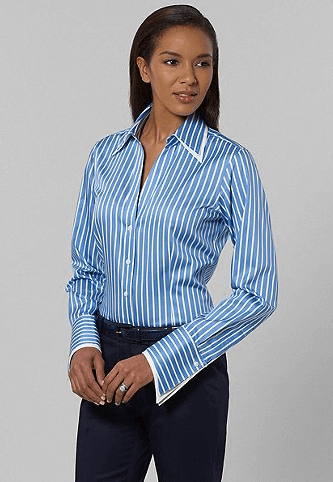
Petite Non-Iron Fitted Double Stripe Dress Shirt with DOW XLA™
Someone was telling us recently that they didn’t wear button-down shirts, didn’t even know how to wear ‘em. So, here ya go…

1. If you’re going for the crisp cotton look, go for non-iron. Brooks Brothers makes a great fitted non-iron shirt. Thomas Pink (very high end, typically thought of as a man’s store) makes amazing button-down shirts for women, also, with interesting prints and a lovely fit.

2. Collars should stay on the inside of the jacket, not splayed open on the outside.

3. If you have a white shirt, try not to put it in the dryer in order to avoid yellowing. Actually, in our experience the iron-free shirts look best when hung dry. (Just pull them taut, a bit, when they’re wet and you’re hanging on the hanger — it always seems to help the fabric figure out where to go.)

4. If you’ve got a French cuff shirt, do not bother with those tiny knots you can buy at places for $10 — you’re wasting your money and time, because they take forever to put in. Instead, make an investment in a good pair of cufflinks — Thomas Pink has great ones; Vivre also has some beautiful ones right now

5. Tucking: If you’re wearing a fitted, button-down shirt (such as the ones from Pink) you can experiment with how it looks untucked. The key is that it can’t be too long — it should hit mid-hip, and no matter what should not be longer than your suit jacket. Silky shirts should always be tucked.

6. If you want a very clean look, there are some stores that make leotard-like button-down shirts. See, for example, Victoria’s Secret.

7. Non-traditional style idea: Wear a short-sleeved button-down shirt beneath a vest or even a t-shirt. (We’ve given up trying to wear anything but silky button-downs beneath full-sleeve sweaters — the static cling gets us every time.)

8. Non-traditional style idea, Part 2: Wear a camisole/tank top underneath the button-down shirt, tuck in the shirt, and only button it up halfway, so people can see the camisole beneath. See Allison Janey in West Wing.

9. Gaping: If your shirt is gaping, this could mean a few things. A) You need a larger size, and should take it to a tailor to get it to fit you the way you want it to. B) You need to wear a camisole beneath it, so when you turn to the side people don’t get a view of your bra. C) You can experiment with Hollywood Tape and so forth to keep it from gaping — we’ve found the camisole is just easier.

10. Beneath the white shirt: Wear a bra that matches your skin tone, and a white camisole, no matter how convinced you are that no one can see through it. We’ve tried the nude camisole, and trust is: white just looks better.

Save 25% at the Brooks Brothers Friends and Family Sale – Promo Code friend56

Share and Enjoy:
  • Print
  • email
  • Facebook
  • Digg
  • del.icio.us
  • De.lirio.us
  • StumbleUpon
  • Technorati

Technorati Tags: , , , , , , , , , , , , , , , , , , , ,

{ 42 comments }

No, we’re neither Debrett’s nor Emily Post, but we know a thing or two about conducting ourselves properly at a business lunch… we’ve also seen some truly bad manners. Thus, whether you’ve been to a million business lunches or you’re just starting out, 10 Things You Should Know:

1. As soon as everyone at the table is seated, that napkin goes in your lap. If you need to get up at some point, the napkin should be folded and placed on your chair. (Not the table — no one likes to look at a dirty napkin.) At the very end of the meal, when everyone is finished eating, you should fold you napkin and put it beneath your plate, to the left. This holds true even if you’re eating at a diner with paper napkins.

2. Your water glass is to your right. Your bread dish is to your left. If you get confused, put your hands in your lap and touch the index finger of your left hand to your left thumb, and do the same with your right — your left hand should form a “b” (for BREAD) and your right hand should form a “d” (for DRINK). We’ve also heard to think “BMW”: bread, middle, water.

[click to continue…]

Share and Enjoy:
  • Print
  • email
  • Facebook
  • Digg
  • del.icio.us
  • De.lirio.us
  • StumbleUpon
  • Technorati

Technorati Tags: , , , , , , , , , , , , , , , , , ,

{ 27 comments }

Terms of Use Privacy Policy